
Prathama Vṛṣṭi
(First Shower)
Prathama Dhara
(First Stream)
Śrī Śrī Rādhā-Kṛṣṇābhyāṁ namaḥ
(Obeisance unto Śrī Śrī Rādhā-Kṛṣṇa)
I offer obeisance to Śrī Kṛṣṇa Caitanya, that bestower of bhakti by whom all erroneous, incomplete, and mutually conflicting doctrines are brought to their ultimate resolution in kṛṣṇa-bhakti. I have now set myself to the composition of the work known as Śrī Śrī Caitanya-Śikṣāmṛta.
Īśvara, cit, and jaḍa — three substances are observed in this world. The names of these three substances are Īśvara (the Supreme), cetana (conscious beings), and jaḍa (inert matter) (1). Those substances that have no will power are jaḍa. Earth, stone, water, fire, air, sky, house, forest, grain, cloth, the physical body and all such things devoid of will we call jaḍa. Human beings, animals, birds, worms, and insects — these are cetana. They possess the power of discrimination and will power. No other conscious being possesses the power of discrimination, in the same way that human beings do. For this reason alone, some people say that the human being is the king of all conscious and unconscious entities. (2).
(1) suparṇāv etau sadṛśau sakhāyau
yadṛcchayaitau kṛta-nīḍau ca vṛkṣe
ekas tayoḥ khādati pippalānnam
anyo niranno ’pi balena bhūyān
These two birds with beautiful wings are alike and are companions. By chance they have made a nest in the same tree. One of them eats the fruit of the pippala tree, while the other, though not eating, is superior by His power. (Śrīmad Bhāgavatam 11.11.6)
(2) sṛṣṭvā purāṇi vividhāny ajayātma-śaktyā
vṛkṣān sarisṛpa-paśūn khaga-dandaśūkān
tais tair atuṣṭa-hṛdayaḥ puruṣaṃ vidhāya
brahmāvabodhā-dhiṣaṇaṁ mudam āpa devaḥ
Creating beforehand the various beings by His unborn internal power — trees, creeping creatures, animals, birds, and snakes — the Lord remained unsatisfied at heart. Then, after creating man, whose intelligence is fit for realisation of Brahman, the Lord became pleased. (Śrīmad Bhāgavatam 11.9.28)
Īśvara is the Creator of all conscious and inert substances. Since He possesses no material body, we cannot perceive Him. He is a complete and pure conscious substance. He is our Creator, Sustainer, and Regulator (3). If He so wills, our welfare comes about. If He so wills, our destruction comes about. He, in His form as Bhagavān, perpetually reigns in Vaikuṇṭhā-dhāma. He is the King of kings. By His will, all activity in the entire universe proceeds.
(3) sthity-udbhava-pralaya-hetur ahetur asya
yat svapna-jāgara-suṣuptiṣu sad bahiś ca
dehendriyāsu-hṛdayāni caranti yena
sañjīvitāni tad avehi paraṁ narendra
O King, know that Supreme Reality to be that by which the body, senses, life-airs, and mind are animated and made to function — moving through the states of waking, dream, and deep sleep, both internally and externally. He is the cause of the creation, maintenance, and dissolution of this universe, though He Himself is without any cause. (Śrīmad Bhāgavatam 11.3.35)
Just as an inert substance possesses a certain gross form, Īśvara does not possess such a form. It is for this reason that we are unable to perceive Him through the senses. It is for this very reason that in the Vedas He has been declared to be formless (nirākāra).
Every substance has a svarūpa (intrinsic nature). Therefore, Īśvara also has a svarūpa (4). The very svarūpa of all material objects is inertness. The svarūpa of a conscious being is of the nature of consciousness. We are indeed conscious beings, yet we are endowed with material bodies. Therefore, our fully conscious svarūpa has become concealed within the fully inert svarūpa. Īśvara is of purely conscious substance. Therefore, apart from His fully conscious svarūpa, He has no other svarūpa. That fully conscious svarūpa is His form. We can behold that form only with our eye when it is fully conscious – that is to say, with the eye of bhakti. (5). We cannot see with the physical eye.
(4) aṅgāni yasya sakalendriya-vṛttimanti
paśyanti pānti kalayanti ciraṁ jaganti
ānanda-cinmaya-sad-ujjvala-vigrahasya
govindam ādi-puruṣaṁ tam ahaṁ bhajāmi
I worship Govinda, the original Person, whose form is replete with bliss, consciousness and eternality, and thus it is supremely splendorous. Each of the limbs of that form is endowed with the functions of all the other senses, and at all times He eternally observes, maintains and creates unlimited spiritual and material worlds. (Brahma-saṁhitā 5.32)
(5) premāñjana-cchurita-bhakti-vilocanena
santaḥ sadaiva hṛdayeṣu vilokayanti
yaṁ śyāmasundaram acintya-guṇa-svarūpaṁ
govindam ādi-puruṣaṁ tam ahaṁ bhajāmi
I worship Govinda, the original Person, whom the sādhus, whose eyes are tinged by the salve of prema, behold in their hearts as Śyāmasundara Kṛṣṇa, possessing inconceivable qualities. (Brahma-saṁhitā 5.38)
Some unfortunate persons do not believe in Īśvara. Their eye of knowledge remains shut. Unable to behold Īśvara’s form with the physical eye, they conclude that they conclude that no one called Īśvara exists. Just as those born blind cannot perceive the light of the sun, so too atheists become incapable of believing in Īśvara (6). By nature, every human being believes in Īśvara. Only those who, from childhood, have learnt false logic in the association of the wicked gradually fall under the sway of corrupt impressions (ku-saṁskāra) and refuse to acknowledge the existence of Īśvara. What harm can come to Īśvara from that? The loss is theirs alone.
(6) pravṛttiṁ ca nivṛttiṁ ca janā na vidur āsurāḥ
na śaucaṁ nāpi cācāro na satyaṁ teṣu vidyate
asatyam apratiṣṭhaṁ te jagad āhur anīśvaram
aparaspara-sambhūtaṁ kim anyat kāma-haitukam
Those who are asuras by nature cannot discriminate as to what actions should be done and what actions should not be done. No purity, proper behaviour or truthfulness can be found in them. They claim that the world is false, without any basis and without any divinity. They believe that the source of everything is the union between male and female and that life has no purpose besides lust. (Bhagavad-gītā 16.7-8)
The spiritual realm (cid-dhāma), or Vaikuṇṭha, is attainable through bhakti. One should not conceive of Vaikuṇṭha-dhāma as any material place. Madras, Bombay, Kashmir, Calcutta, London, Paris – all such places are material. To travel there, one must traverse many material lands or countries. Even going by ship or by railroad takes a great deal of time. One has to proceed by moving the material body step by step. However, Vaikuṇṭha is not a region of that kind. It is a particular abode which is entirely beyond the entirety of the material world (7).
(7) śriyaḥ kāntāḥ kāntaḥ parama-puruṣaḥ kalpa-taravo
drumā bhūmiś cintāmaṇi-gaṇa-mayi toyam amṛtam
kathā gānaṁ nāṭyaṁ gamanam api vaṁśī priya-sakhi
cid-ānandaṁ jyotiḥ param api tad āsvādyam api ca
sa yatra kṣīrābdhiḥ sravati surabhībhyaś ca su-mahān
nimeṣārdhākhyo vā vrajati na hi yatrāpi samayaḥ
bhaje śvetadvīpaṁ tam aham iha golokam iti yaṁ
vidantas te santaḥ kṣiti-virala-cārāḥ katipaye
In that place, where there are divine Lakṣmīs in the form of lovers, Kṛṣṇa, the Supreme Person, is the only beloved. The trees there are desire-trees, the land itself is cintāmaṇi, in other words, in is comprised of spiritual jewels. The water is nectar, words are songs, walking is a dance, the flute is the dearest friend, light is full of consciousness and bliss, and supreme transcendental elements are relishable and pleasurable. In that place, a great ocean of milk is continuously flowing from millions and millions of surabhī cows, and transcendental time is in the eternal present without the phases of past and future, thus there is not even half a moment of the past. I worship that supreme seat, Śvetadvīpa. This abode known as Goloka is seldom known by very few sādhus in this material world. (Brahma-saṁhitā 5.56)
That abode is conscious, eternal, and devoid of defects. It cannot be seen by the physical eyes, nor conceived of by the mind. The Lord Supreme resides in that inconceivable realm. If we are able to satisfy Him, we too shall go there and serve the Supreme Lord eternally. Here, what we call happiness is not eternal; it remains but a short while and then vanishes. Here, everything is full of suffering. Birth itself is a matter of great distress and pain. Once born, the body must be nourished by food and the like, and the lack of such food and sustenance causes misery. Illness is ever-present. Cold, heat, and all manner of hardships abound. To relieve all these sufferings, one must endure great bodily toil to earn wealth. Without building a house one cannot live. One must marry and beget children. As one gradually grows old, nothing seems pleasant any more. In the midst of all this, through quarrels and disputes with others, much torment is experienced. In brief, there is no such thing as ‘untainted happiness’ in this world. People mistake momentary relief from suffering and deprivation as ‘happiness.’ When this present, transient world of pleasure and pain is left behind, we shall attain unceasing eternal bliss. Therefore, satisfying the Supreme Lord is our sole duty.
From the very time that knowledge arises in a human being, one should engage in seeking the satisfaction of the Supreme Lord (8). To think, “For the present let us enjoy the pleasures of the material world, and in old age we shall engage in satisfying Īśvara” – such thinking shall avail nothing. Time is exceedingly rare. From the very day that one becomes aware of one’s duty, one must diligently strive to carry it out. In particular, human life is extremely rare and unstable (9). One cannot say which day death will arrive. “It is not possible to practice devotion to the Supreme Lord during childhood” – it is improper to think like that. We see in history that Dhruva and Prahlāda received the grace of the Supreme Lord in their very early childhood. If any human being is capable of accomplishing a certain task, then surely any human being, by making proper effort, can accomplish that task — what doubt can there be in this? In particular, that which is practised from an early age gradually becomes one’s second nature.
(8) kaumāra ācaret prājño dharmān bhāgavatān iha
durlabhaṁ mānuṣaṁ janma tad apy adhruvam arthadam
yathā hi puruṣasyeha viṣṇoḥ pādopasarpaṇa
yad eṣa sarva-bhūtānāṁ priya ātmeśvaraḥ suhṛt
An intelligent person should practice the duties of devotion to Bhagavān from early childhood in this very life, for human birth is rare, and although temporary, it bestows the highest value. For in this world, that alone is truly beneficial for a person which leads one toward the lotus feet of Vishnu, since He is the beloved, the indwelling Self, the Lord, and the well-wishing friend of all beings. (Śrīmad Bhāgavatam 7.6.1-2)
(9) labdhvā sudurlabham idaṁ bahu-sambhavānte
mānuṣyam arthadam anityam apīha dhīraḥ
tūrṇaṁ yateta na pated anu mṛtyu yāvan
niḥśreyasāya viṣayaḥ khalu sarvataḥ syāt
Having obtained this human birth after many existences, though impermanent, it grants true value. A sober person should endeavour without delay for his supreme welfare, before he falls under death, for sense enjoyment is indeed obtainable everywhere. (Śrīmad Bhāgavatam 11.9.29)
The four causes that may be observed for the efforts that human beings make, according to their different conditions, in order to satisfy the Supreme Lord (10) are fear (bhaya), hope (āśā), a sense of duty (kartavya-buddhi), and attraction (rāga). Those who worship the Supreme Lord fearing hell, poverty, affliction, and death perform the worship of Īśvara impelled by fear. Those who engage in hari-bhajana while praying for worldly pleasures and material advancement are driven by hope and must therefore be said to pursue īśvara-sādhana through desire. However, there is such pure joy in īśvara-sādhana that many who first enter upon it through fear or hope ultimately abandon both fear and hope and become attached to pure bhajana. Those who worship the Creator with gratitude toward Him engage in that practice, being guided by a sense of duty. Those who, without being driven by fear, hope, or duty, naturally find delight in īśvara-sādhana – they are engaged in that activity by affection. Rāga is that disposition by which the mind rushes toward an object upon the very first sight of it, before any deliberation. One in whose heart that disposition arises the moment one contemplates the Supreme Lord performs īśvara–bhajana through rāga.
(10) tuṣṭe ca tatra kim alabhyam ananta ādye
kiṁ tair guṇa-vyatikarād iha ye sva-siddhāḥ
dharmādayaḥ kim aguṇena ca kāṅkṣitena
sāraṁ juṣāṁ caraṇayor upagāyatāṁ naḥ
dharmārtha-kāma iti yo ’bhihitas tri-varga
īkṣā trayī naya-damau vividhā ca vārtā
manye tad etad akhilaṁ nigamasya satyaṁ
svātmārpaṇaṁ sva-suhṛdaḥ paramasya puṁsaḥ
When that infinite, primeval Lord is pleased, what indeed remains unattainable? What need is there then for those separately cultivated achievements such as dharma etc., which arise from the interactions of the material qualities and are attainable even on their own? And what value is there in desires unrelated to Him for those of us who relish singing the glories of His lotus feet? Dharma, artha, and kāma – the so-called threefold goals of life; the Vedas; philosophical inquiry; political science; self-control; and the various worldly occupations –= I consider all of these to find their true fulfillment in the complete offering of oneself unto the Supreme Person, the dearest friend of the ātmā. (Śrīmad-Bhāgavatam 7.6.25-26)
The bhajana of those worshippers who worship Īśvara driven by fear, hope, or a sense of duty is not so pure (11). Those who engage in the worship of Īśvara through the path of rāga are true sādhakas. There exists a profound and hidden relationship between the jīva and Īśvara. When rāga arises, that relationship becomes recognisable. That relationship is indeed eternal, but for the jīva who is bound by matter, it remains concealed. Whenever an opportunity presents itself, it becomes manifest. Just as fire is revealed when a matchstick is struck or a flint is sparked, so too, through the process of sādhana, that relationship becomes manifest. By worshipping progressively through fear, hope, and a sense of duty, many have eventually awakened that relationship. Dhruva at first performed hari-bhajana with the hope of gaining a kingdom, but as his sādhana progressed, that rāga born of a pure relationship arose in his heart, and he no longer accepted any boon conducive to worldly happiness.
(11) gopyaḥ kāmād bhayāt kaṁso dveṣāc caidyādayo nṛpāḥ
sambandhād vṛṣṇayaḥ snehād yūyaṁ bhaktyā vayaṁ vibho
O King, the cowherd women attained Him through kāma (love), Kaṁsa through bhaya (fear), kings such as Śiśupāla through dveśa (hatred), the Vṛṣṇīs through sambandha (familial relationships), you Pāṇḍavas through sneha (affection), and we sages through bhakti, (Śrīmad Bhāgavatam 7.1.31)
Fear and hope are extremely inferior. When a sādhaka’s intelligence matures, then he abandons fear and hope, and at that point the sense of duty alone becomes his sole refuge. So long as rāga toward the Supreme Lord has not yet arisen, the sādhaka does not abandon a sense of duty. From that sense of duty two considerations arise – a respect for what is enjoined (vidhi) and rejection of what is prohibited (avidhi). The methods for practising devotion to the Supreme Lord which the great personalities of former ages established through deliberation and recorded in the śāstra are called vidhi (12). Submission to the sense of duty and respect for vidhi come into being.
(12) ei ta sādhana-bhakti dui ta’ prakāra
eka vaidhī bhakti rāgānugā-bhakti āra
rāga-hīna jana bhaje śāstrera ājñāya
‘vaidhī bhakti’ bali’ tāre sarva-śāstre gāya
There are thus two kinds of sādhana-bhakti – one is vaidhī-bhakti, and the other is rāgānugā–bhakti. A person devoid of spontaneous attachment worships according to the injunctions of śāstras; all the śāstras describe that as vaidhī-bhakti. (Caitanya-caritāmṛta Madhya-līlā 22.108-109)
dāsa-sakhā-pitrādi-preyasīra gaṇa
rāga-mārge nija-nija-bhāvera gaṇana
The groups of servants, friends, parents, and beloved consorts are each counted according to their own particular bhāva on the path of rāga. (Caitanya-caritāmṛta Madhya-līlā 22.161)
na karhicin mat-parāḥ śānta-rūpe
naṅkṣyanti no me ’nimiṣo leḍhi hetiḥ
yeṣām ahaṁ priya ātmā sutaś ca
sakhā guruḥ suhṛdo daivam iṣṭam
Those who are devoted exclusively to Me are never destroyed. My unfailing weapon of time does not consume them, for I am to them their beloved, their very self, their son, their friend, their guru, their well-wisher, and their worshipful Lord. (Śrīmad-Bhāgavatam 3.25.38)
If one examines the histories and accounts of human beings dwelling throughout various countries, foreign lands, and distant islands, it becomes clearly evident that belief in God is a universal characteristic of the human race. Even uncivilised tribal people, though they spend their lives eating animal flesh like beasts, nevertheless bow down in prostration before the sun and moon, great mountains, mighty rivers, and enormous trees, worshipping them as providers and controllers. What is the reason for this? Even though the jīva is utterly bound, so long as his consciousness has not been fully covered, a certain degree of belief in Īśvara – characteristic of the nature of consciousness – shall inevitably be manifested. (13) Having attained a state of civilisation, when he discusses various forms of knowledge, then by means of faulty logic he somewhat obscures that belief, and either grants prominence to atheism or accepts nirvāṇavāda (impersonalism) within the category of abhedavāda (non-dualism).
(13) kālena naṣṭā pralaye vāṇīyaṁ veda-saṁjñitā
mayādau brahmaṇe proktā dharmo yasyāṁ mad-ātmakaḥ
tena proktā sva-putrāya manave pūrva-jāya sā
tato bhṛgv-ādayo ’gṛhṇan sapta brahma-maharṣayaḥ
tebhyaḥ pitṛbhyas tat-putrā deva-dānava-guhyakāḥ
manuṣyāḥ siddha-gandharvāḥ sa-vidyādhara-cāraṇāḥ
kindevāḥ kinnarā nāgā rakṣaḥ-kimpuruṣādayaḥ
bahvyas teṣāṁ prakṛtayo rajaḥ-sattva-tamo-bhuvaḥ
yābhir bhūtāni bhidyante bhūtānāṁ patayas tathā
yathā-prakṛti sarveṣāṁ citrā vācaḥ sravanti hi
evaṁ prakṛti-vaicitryād bhidyante matayo nṛṇām
pāramparyeṇa keṣāñcit pāṣaṇḍa-matayo ’pare
At the time of dissolution, this teaching known as the Veda was lost by the influence of time. In the beginning of creation, I spoke it to Brahma, within which is contained the dharma centered upon Me. Brahmā then taught it to his eldest son, Manu, and thereafter Bhṛgu and the other seven great sages among the brāhmaṇas received it from him. From those forefathers, their sons received it – the Devas, Dānavas, Guhyakas, human beings, Siddhas, Gandharvas, Vidyādharas, and Cāraṇas; as well as Kimpuruṣas, Kinnaras, Nāgas, Rākṣasas, and many others. Among them exist many different natures born of rajas, sattva, and tamas. According to these natures, beings become differentiated, as do the rulers among beings. According to their respective natures, diverse expressions and teachings flow forth from all of them. Thus, because of the diversity of material nature, the opinions of human beings also become diverse. Through disciplic succession some hold authentic traditions, while others adopt heretical doctrines. (Śrīmad Bhāgavatam 11.14.3-8)
All those degraded beliefs are to be understood as merely symptoms of the ill-health of a conscious being whose strength has not yet been fully developed. Between the state of utter barbarism and the state well-suited to a beautiful faith in Īśvara, three intermediate stages of human life are observed. In each of those three stages, the afflictions of nāstika-vāda (atheism), jaḍa-vāda (materialism), sandeha-vāda (scepticism), and nirvāṇa-vāda (impersonalism) act as obstacles to the jīva’s progress and lead certain individuals into a degraded condition. It is not the case that all people in every condition become afflicted by those diseases. Those who are afflicted by them remain bound in those respective conditions and do not the eligibility for a higher life. Uncivilised and wild people, through the power of civilisation, ethics, and the cultivation of knowledge, very quickly take shelter of that dharma known as varṇāśrama and thereby attain a life of bhakti suitable for the sādhana of īśvara-bhakti. This is the natural course of progress for the human race. When obstructing diseases arise, life falls into an unnatural condition.
Human beings, residing in different countries and different islands, have adopted different natures. The primary nature of human beings is everywhere one and the same. The secondary nature differs from person to person. Although the primary nature of human beings is one, one shall not find two persons in the world whose secondary natures are entirely identical. When even two brothers born from the same womb differ from each other in form and disposition and are never identical in every respect, how will human beings, born in different countries, ever attain unity? The water, air, mountains, forests etc. as well as foodstuffs, and articles suitable for clothing in different countries all differ from one another. Thereby the appearance, complexion, conduct, dress, and diet of people born in those respective lands naturally become distinct from one another. The disposition of the mind likewise differs according to the particular country. The conception of Īśvara contained therein, though one in its primary aspect, becomes varied in its secondary aspects. For this reason, in every land and country, as human beings gradually pass beyond the uncivilised state and attain in succession the civilised state, the scientific state, the ethical state, and the state of bhakti, there correspondingly arises differences of language, of dress, of food, of mental disposition, and gradually the modes of worship of Īśvara also become varied. If one judges impartially, no harm comes from such secondary differences. So long as there is unity in the essential matter of worship, no fault arises in the end. Therefore, the particular command of Śrīman Mahāprabhu is that one should worship Bhagavān, whose nature is pure truth, but should not condemn the modes of worship belonging to other classes of eligible practitioners. (14)
(14) anya-deva anya-śāstra nindā nā kariba
Do not criticise other Devas or other śāstras. (Caitanya-caritāmṛta, Madhya-līlā 22.119)
śraddhāṁ bhāgavate śāstre’nindam anyatra cāpi hi
Have faith in the Bhāgavatam, and do not criticise other śāstras. (Śrīmad Bhāgavatam 11.3.26)
On account of the reasons stated above, among the religions propagated by the peoples of various countries, the following several varieties of difference may be observed, namely:
- Differences in teachers (ācāryas).
- Difference in the mental disposition of the worshipper and in the experience of worship.
- Difference in the method of worship.
- Difference in conceptions and practices regarding the tattva of the object of worship.
- Difference in names and expressions according to difference of language.
Due to differences in ācāryas, in some lands the ṛṣis, or preachers such as Muḥammad, religious teachers such as Jesus, and in various countries and foreign lands many learned persons, enjoy particular and special veneration. To render appropriate honour to each of those ācāryas is an absolute duty in each of those respective lands. However, even if one holds the belief, for the sake of personal steadfastness of faith, that the teachings of the ācārya of one’s own country are superior to those of ācāryas of all other countries, it is not proper to propagate such a contentious position in other countries. By doing so, not even the slightest good is done to the world.
Different methods of worship arise according to differences in thought and spiritual feeling. According to the varying mental dispositions and devotional experiences of worshippers, in some countries worship is performed while seated upon an āsana, accompanied by nyāsa, prāṇāyāma, and similar practices; elsewhere, they wear loose garments, and people stand or fall prostrate facing the principal temple of their worship and offer prayers five times daily; again elsewhere, they kneel and with folded hands, express humility and sing the glories of the Lord – worship is performed either in temples or in homes. In connection with this worship, various local considerations regarding special dress, food habits, purity, impurity etc. are set down in writing.
When worship in different religions is observed, distinctions in the mode of worship will be noted. In different religions, differences in sentiment and action in regard to the upāsya-tattva (the principle of the object of worship) are observed. Some, with hearts overflowing with bhakti, establish a sacred image (śrī-mūrti) as a reflection of the Supreme Lord within their ātmā, their mind, and the world. They perform worship thereof with a sense of identity with the worshipped. Due to a greater inclination toward rationalism, in certain religions, a concept of Īśvara is formed mentally and worship is directed toward that; there is no acceptance of any physical image. Yet in truth, these are all forms of image-worship. (15)
(15) arcāyāṁ sthaṇḍile ’gnau vā sūrye vāpsu hṛdi dvijaḥ
dravyeṇa bhakti-yukto ’rcet sva-guruṁ mām amāyayā
A brāhmaṇa should worship Me with bhakti and without duplicity – in the Deity form, upon sacred ground, in fire, in the sun, in water, or within the heart – using appropriate offerings, and also he should worship his own guru. (Śrīmad Bhāgavatam 11.27.9)
śailī dāru-mayī lauhī lepyā lekhyā ca saikatī
mano-mayī maṇi-mayī pratimāṣṭa-vidhā smṛtā
The Deity should be remembered as being of eight kinds – made of stone, wood, metal, clay, painted/drawn, sand, conceived within the mind, and made of jewels. (Śrīmad Bhāgavatam 11.27.12)
According to differences of language, various persons address the Supreme Lord by various names. They also give different names to religion itself. The words employed during worship also differ.
According to these five kinds of differences, it is natural that the various religions of the world will differ greatly from one another. Yet to quarrel with one another on account of such differences is altogether unjust and harmful. When one is present in another’s place of worship at the time of his worship, one ought to remain in this spirit – “A different mode of worship of the same Supreme Truth that I adore is taking place here. By reason of my separate habitual practice, I am unable to fully enter into this method; yet by seeing this, a greater upsurge of feeling arises in me for my own process. The Supreme Truth is one, not two. Therefore I bow down before the symbol that I see here, and I pray to my Lord, who bears this different form, That He may enrich my love for Him in the form most suitable to me.” (16)
(16) śrī-nāthe janakī-nāthe cābhedaḥ paramātmani
tathāpi mama sarvasvaḥ rāmaḥ kamala-locanaḥ
There is no difference in Paramātmā as the Lord of Lakṣmī and Rāma as the Lord of Sītā; nevertheless, the lotus-eyed Rāma is my everything. (Śrī Hanumān)
Those who, instead of conducting themselves in this manner, harbour hatred, malice, envy, or censure toward different methods of worship, are utterly hollow and bereft of good sense. They do not cherish their ultimate necessity as much as they cherish futile argumentation.
Within this topic, only one point is to be considered. To censure the diversity of methods of worship is indeed hollow, but if any genuine fault is observed, it shall on no account be tolerated. (17) Rather, it is beneficial for the jīva if one attempts to correct the fault in the proper way. It was for this very reason that Śrī Śrī Mahāprabhu debated with the Buddhists, Jains, and Nirviśeṣavādīs and brought them onto the right path. The character of the Lord ought to serve as an ideal model for all devotees of the Lord in every respect.
In whatever religion the evils of atheism (nāstikya-vāda), scepticism (sandeha-vāda), materialism (jaḍa-vāda), denial of the self (anātma-vāda), naturalism (svabhāva-vāda), and impersonalism (nirviśeṣa-vāda) are found, devotees shall not regard such a system as true dharma. They understand it to be to be vidharma (obstructive religion), chala-dharma (deceptive religion), dharmābhāsa (a semblance of religion), or adharma (irreligion), and consider the condition of its worshippers to be pitiable. They shall endeavour, to whatever extent possible, to protect the jīva from all these evils.
(17) vidharmaḥ para-dharmaś ca ābhāsa upamā chalaḥ
adharma-śākhāḥ pañcemā dharma-jño ’dharmavat tyajet
Vidharma (obstructive religion), para-dharma (contrived religion), ābhāsa (a semblance of religion), upamā (imitative religion), and chala (deceptive religion) – these five are branches of adharma that those who know dharma reject as irreligion. (Śrīmad Bhāgavatam 7.15.12)
dharma-bādho vidharmaḥ syāt para-dharmo ’nya-coditaḥ
upadharmas tu pākhaṇḍo dambho vā śabda-bhic chalaḥ
yas tv icchayā kṛtaḥ pumbhir ābhāso hy āśramāt pṛthak
sva-bhāva-vihito dharmaḥ kasya neṣṭaḥ praśāntaye
Vidharma is that which obstructs dharma. Para-dharma is that which is prescribed for another. Upa-dharma is hypocrisy or deceitful practice; and chala is trickery based on words. That which is undertaken by people according to their own desire, but is merely a semblance, different from one’s proper āśrama – such (false) appearances are separate from true religious order. Who would not accept that dharma which is in accordance with one’s own nature, and which leads to peace? (Śrīmad Bhāgavatam 7.15.13-14)
Uncontaminated love (vimala-prema) is the eternal dharma of the jīva (18). Although the five kinds of difference mentioned above may be observed, that religion in which pure love is the intended truth – that alone is true dharma. It is improper to argue over external differences; if the aim of a religion is pure, then everything in it is possessed of auspicious characteristics. Atheism, scepticism, polytheism, materialism, and the denial of the ātmā – these are dealt with in other places in this work.
(18) dharmaḥ svanuṣṭhitaḥ puṁsāṁ viṣvaksena-kathāsu yaḥ
notpādayed yadi ratiṁ śrama eva hi kevalam
If dharma, well executed by a person, does not produce attachment to the topics of the Supreme Lord, then it is mere labour. (Śrīmad Bhāgavatam 1.2.8)
Kṛṣṇa-prema is uncontaminated love (19). The essential nature of prema is that it takes principle as the āśraya (receptacle of love) and accepts another principle as the viṣaya (object of love). Without a viṣaya and an āśraya, prema cannot be known. The heart of the jīva is the very receptacle of prema. When pure and perfect prema arises, the nature of the object of worship – the nature of Brahman, the nature of Īśvara, and the nature of Nārāyaṇa – all become resolved in the svarūpa of Śrī Kṛṣṇa. The more one reads these books and reflects upon prema, the more conviction of this truth will grow.
One who, upon hearing kṛṣṇa-nāma, argues about the Name, is deprived of the truth. Arguments about names is futile. That object that the Name indicates is what is to be attained by the jīva.
(19) bhakti-yogena manasi samyak praṇihite ’male
apaśyat puruṣaṁ pūrṇaṁ māyāṁ ca tad-apāśrayām
yayā sammohito jīva ātmānaṁ tri-guṇātmakam
paro ’pi manute ’narthaṁ tat-kṛtaṁ cābhipadyate
anarthopaśamaṁ sākṣād bhakti-yogam adhokṣaje
lokasyājānato vidvāṁś cakre sātvata-saṁhitām
yasyāṁ vai śrūyamāṇāyāṁ kṛṣṇe parama-pūruṣe
bhaktir utpadyate puṁsaḥ śoka-moha-bhayāpahā
When the mind is perfectly purified and fixed through bhakti-yoga, one directly perceives the complete Supreme Person, along with His external energy, which is under His control. Deluded by that very māyā, the living being, though transcendental, thinks himself to be composed of the three modes of nature, and thus accepts miseries born of that false identification. The removal of all material entanglement is directly achieved through bhakti–yoga directed toward the Supreme Lord Kṛṣṇa. Therefore, the wise Vyāsa composed the Śrīmad Bhāgavatam as the essence of all Vedic conclusions, for the benefit of people who are unaware of this truth. Simply by hearing this, bhakti arises in the heart of a person toward the Supreme Person, and that destroys lamentation, illusion, and fear. (Śrīmad Bhāgavatam 1.7.4-7)
In the Śrīmad Bhāgavatam, the crest-jewel of all śāstras, the nectarean account of Śrī Kṛṣṇa’s pastimes has been recorded – and this is the truth directly obtained by the great Śrī Vyāsadeva through samādhi. Following the instruction of Śrī Nārada, when Vyāsadeva took shelter of the natural samādhi of bhakti, he had darśana of the svarūpa of Śrī Kṛṣṇa, and he described the nectar of the Lord’s pastimes in such a way that bhakti – free from material designations and which destroys sorrow, illusion, and fear – arises within the jīva toward that Supreme Person, Kṛṣṇa.
When the nectarean narrations of Śrī Kṛṣṇa are read or heard, two kinds of conviction arise in the jīva according to his qualification. These two kinds of conviction are called vidvat–pratīti (conviction based on proper knowledge) and avidvat-pratīti (conviction based on improper knowledge). Even those pastimes of Śrī Kṛṣṇa that were visible to mundane eyes during His manifest appearance on earth produce vidvat-pratīti in the wise and avidvat–pratīti in those of materialistic intelligence. To understand vidvat-pratīti and avidvat-pratīti, one should carefully study the Ṣaṭ-sandarbha, the Bhāgavatāmṛta, or my own Śrī Kṛṣṇa-saṁhitā, and then discuss them with a qualified person. It is difficult to elaborate upon this matter here. In brief, the meaning is this – the conviction that arises under the shelter of knowledge is vidvat-pratīti; the conviction that arises under the shelter of ignorance is avidvat-pratīti.
All controversies that arise concerning Śrī Kṛṣṇa’s nectarean pastimes do so by following avidvat-pratīti. In vidvat-pratīti there is no controversy. (20)
Those who have a desire to attain the supreme spiritual goal, let them swiftly obtain the perception born of vidvat-pratīti. What need is there to uselessly quarrel over the perception of avidvat-pratīti, and thereby accept genuine harm to one’s own true interest? (21)
(20) na cāsya kaścin nipuṇena dhātur
avaiti jantuḥ kumanīṣa ūtīḥ
nāmāni rūpāṇi mano-vacobhiḥ
santanvato naṭa-caryām ivājñaḥ
sa veda dhātuḥ padavīṁ parasya
duranta-vīryasya rathāṅga-pāṇeḥ
yo ’māyayā santatayānuvṛttyā
bhajeta tat-pāda-saroja-gandham
No living being, however clever, can fully understand the actions and intentions of the Supreme Creator. The foolish cannot comprehend His names and forms, which He expands through His own energy in manifold ways, like a dramatic performance enacted by a stage actor. Only one who constantly and sincerely follows the path of devotion, free from illusion, can know Kṛṣṇa, the holder of the chariot-wheel, who possesses unlimited potency. Such a person alone understands the true position of that Supreme Creator and becomes able to experience the fragrance of His lotus feet. (Śrīmad Bhāgavatam 1.3.37-38)
(21) vidyāvidye mama tanū viddhy uddhava śarīriṇām
mokṣa-bandha-karī ādye māyayā me vinirmite
ekasyaiva mamāṁśasya jīvasyaiva mahā-mate
bandho ’syāvidyayānādir vidyayā ca tathetaraḥ
O Uddhava, know that knowledge and ignorance are both My energies, manifest in the embodied beings. They are created by My māyā—knowledge leads to liberation, and ignorance leads to bondage. O greatly intelligent one, for the individual soul, who is My own partial expansion, bondage arises from beginningless ignorance, and liberation arises through knowledge. (Śrīmad Bhāgavatam 1.11.3-4)
I have begun to attempt to give a small indication of vidvat-pratīti. Only those who are able to transcend material thinking and realise cit (the conscious principle) are capable of vidvat–pratīti. They behold the form of Kṛṣṇa through the eye of consciousness (cic-cakṣu), they hear Kṛṣṇa’s līlā through the ear of consciousness (cit-karṇa), and they relish Kṛṣṇa in every way through the mellows of consciousness (cid-rasa). All of Kṛṣṇa’s pastimes are transcendental and beyond inert matter. By Kṛṣṇa’s acintya-śakti He may become an object of the material eye, yet in all likelihood the material senses such as the eye are unable to directly behold Him. Even those pastimes of Bhagavān which, during His manifest appearance, become perceptible to the mundane senses, cannot yield the results of direct perception of the true object without vidvat-pratīti. Therefore, ordinarily it is only avidvat-pratīti that is obtained. Through avidvat-pratīti many persons regard the kṛṣṇa-tattva as a perishable entity, and conceive of birth, growth, and decay in Kṛṣṇa’s body. It is solely through avidvat-pratīti that the state of nirviśeṣa (no transcendental attributes) appears as ‘real’ and the state of saviśeṣa (possession of transcendental attributes) appears as ‘mundane.’ Therefore, even though this unique feature resides in kṛṣṇa-tattva, that too is concluded by them to be material.
To determine what the Supreme Reality actually is is not the work of logic. What can finite human reasoning accomplish in regard to an immeasurable Reality? Thus, through the devotional faculty (bhakti-vṛtti) inherent in the jīva, the Supreme Reality may be known and relished. What we call vimala-prema (uncontaminated love) acquires the name ‘bhakti’ in its preliminary stage. Without Kṛṣṇa’s grace, vidvat-pratīti does not arise, for it is by Kṛṣṇa’s grace that the power of knowledge (vidyā-śakti) becomes the jīva’s helper.
Of all the conceptions of the Supreme Reality that have been observed in this world, the conception of Kṛṣṇa’s svarūpa is uniquely the most fitting object for vimala-prema, surpassing all others. In the Muslim scriptures, the conception of Allah that has been established is such that vimala-prema cannot be engaged therein. Even His most beloved friend, the Prophet, was unable to directly behold His svarūpa. This is because, even when the worshipped reality is of a friendly nature, on account of His awe-inspiring majesty (aiśvarya), He remains distant from the worshipper. In Christianity, the conception of ‘God’ is also an exceedingly distant reality. Of Brahman there is no question at all. Even Nārāyaṇa does not become the object of a jīva’s natural prema. Kṛṣṇa alone is the direct object of vimala-prema. (22) In His transcendental svarūpa, He eternally resides in the transcendental Vraja-dhāma.
(22) anyābhilāṣitā-śūnyaṁ jñāna-karmādy-anāvṛtam
ānukūlyena kṛṣṇānuśīlanaṁ bhaktir uttamā
The highest type of bhakti is that which is free from all desires, not covered by jñāna, karma etc. and which is favourable for service to Kṛṣṇa. (Bhakti-rasāmṛṭa-sindhu 1.1.11)
Kṛṣṇa’s abode is full of bliss. Although aiśvarya is present there in its fullness, its influence is not felt. (23) Everything there is pervaded by sweetness (mādhurya) and is of the nature of eternal bliss.
Fruits, flowers, and tender leaves are the wealth of that place. The herds of cows are the subjects. The cowherd boys are the companions. The gopīs are the intimate associates. Butter, yoghurt, and milk are the foodstuffs. Every forest and grove is filled with love for Kṛṣṇa. The river Yamunā is devoted to the service of Kṛṣṇa. Nature itself is the handmaiden of Kṛṣṇa. He who elsewhere, in the form of the Supreme Brahman, receives the worship and reverence of all —He is the sole treasure of life in that abode. Sometimes it seems that He is equal to His worshippers, and sometimes it seems He is even lower than them.
(23) tasmād arthāś ca kāmāś ca dharmāś ca yad-apāśrayāḥ
bhajatānīhayātmānam anīhaṁ harim īśvaram
Therefore, since dharma, artha, and kāma are all dependent upon Him, one should worship the desireless Hari, the Supreme Controller, without any ulterior motive. (Śrīmad Bhāgavatam 7.7.48)
nālaṁ dvijatvaṁ devatvam ṛṣitvaṁ vāsurātmajāḥ
prīṇanāya mukundasya na vṛttaṁ na bahu-jñatā
na dānaṁ na tapo nejyā na śaucaṁ na vratāni ca
prīyate ’malayā bhaktyā harir anyad viḍambanam
O sons of the demons, being a twice-born, being a Deva, or being a sage, is not sufficient to please Kṛṣṇa. Nor are good conduct or great learning enough.Neither charity, nor austerity, nor sacrifice, nor purity, nor vows are what please Him. The Lord is pleased only by pure, spotless devotion; everything else is merely a show. (Śrīmad Bhāgavatam 7.7.51-52)
tato harau bhagavati bhaktiṁ kuruta dānavāḥ
ātmaupamyena sarvatra sarva-bhūtātmanīśvare
Therefore, O Dānavas, cultivate bhakti toward Hari, the Supreme Lord, who is the Lord of all beings, regarding everything, everywhere, with a sense of equanimity based on the self. (Śrīmad Bhāgavatam 7.7.53)
Kṛṣṇa, whose majestic opulence is softened and who is full of sweetness, is the prema–viṣaya (the object of love), for were it not so, could a small jīva love the Supreme Truth? The Supreme Truth is the embodiment of the highest līlā, is fully self-willed, and is desirous of the pure love of the jīvas. Would Īśvara, by nature, crave worship as human beings do, or would He feel personal happiness upon being satisfied by worship? Concealing all His opulences by the power of His sweetness, Kṛṣṇacandra, who is the very reservoir of the most wonderfully charming rasa of līlā — accepts equality and even inferiority in relation to the jīvas who are entitled to the rasa of the transcendental Vṛndāvana, and thereby gains delight Himself.
Who else but Kṛṣṇa could those who acknowledge pure and perfect love as their sole necessity choose as the object of that love? Although in various languages the words Kṛṣṇa, Vṛndāvana, gopa, gopī, go-dhana, Yamunā, kadamba etc. may not be explicitly written, nevertheless, for the practitioners of pure love, the principles relating to name, abode, instruments, form, and pastimes, though described in various ways and expressions, must be accepted. Hence, there is no object of pure prema apart from Kṛṣṇa.
So long as pure rāga has not arisen, the sādhaka must necessarily continue the cultivation of Kṛṣṇa by following the secondary and primary rules with a sense of duty. (See the Second Shower).
When one examines the matter deeply, it is seen that there are only two means for the sādhana of kṛṣṇa-prema, namely vidhi (regulated practice) and rāga (spontaneous attachment). Rāga is rare. When rāga arises, the force of vidhi no longer remains. So long as rāga has not arisen, it is the primary duty of human beings to take shelter of vidhi. Therefore the śāstras mention two paths, namely the path of vidhi (vidhi-mārga) and the path of rāga (rāga-mārga). The rāga-mārga is entirely independent; hence there are no specific regulations for it. Only those who are exceedingly fortunate and of the highest qualification are capable of treading that path. For this reason, only the regulations of vidhi-mārga have been written out in an orderly manner.
Unfortunately, those who do not accept the Supreme Lord also establish certain rules for the conduct of their lives — rules which may be called ‘ethics’ (nīti). That system of ethics which makes no provision for the contemplation of the Supreme Lord, even if it be beautiful in other respects, is not capable of fulfilling the true purpose of human life. Such ethics is entirely bahirmukha-nīti (ethics which are averse to the Supreme).
When ethics is combined with faith in Īśvara and the regulation of one’s duty towards Īśvara, that ethics alone is honoured as the vidhi of human life. Vidhi is of two kinds – primary (mukhya) and secondary (gauṇa).
When the satisfaction of Īśvara is the sole purpose of life, that vidhi which directly aims at that purpose is called the mukhya–vidhi. That vidhi which aims at a purpose with some distance is gauṇa-vidhi. A single example will make the matter clear. Morning bathing is a rule. By bathing in the morning, the body becomes clean and free from disease, and thereby the mind becomes steady. When the mind is steady, worship of Īśvara becomes possible. Here, the life’s essential purpose, worship of Īśvara, is not achieved without an intermediary; for the immediate result of bathing is only bodily cleanliness. The result of bodily cleanliness is not directly obtained. Thus, between the result in the form of worship of Īśvara and the rule of bathing, other results remain as intervening steps. Where there is such an intermediary, there is also the possibility of obstruction.
The immediate result of mukhya-vidhi is worship of Bhagavān. (24) Between such a rule and worship there is no intermediate result. Hari-kīrtana and hearing of hari-kathā may be called mukhya-vidhi, because their direct result is the worship of Bhagavān. Even while always remembering that hari-bhakti is mukhya-vidhi, if one does not resort to gauṇa-vidhi, the sustenance of bodily life is not maintained; and if bodily life is not maintained, life itself does not continue. If life does not continue, how can the mukhya-vidhi in the form of hari-bhajana be practised? The simple characteristic of gauṇa-vidhi is this – it embraces all the earthly sciences, arts and crafts, civilisation, orderliness and industry, as well as physical, mental and social codes of conduct – all of which are as ornaments to human life – and it pledges to cause human life to partake sincerely of the nectar of Bhagavān’s lotus feet. In truth, by becoming subordinate to mukhya-vidhi, and by the grace of its presiding principle, that stream of nectar from the Lord’s feet makes human life supremely blissful, both in sādhana and in achieving the result.
(24) neha yat karma dharmāya na virāgāya kalpate
na tīrtha-pada-sevāyai jīvann api mṛto hi saḥ
In this world, that activity which does not lead to dharma, nor to vairāgya (detachment), nor to service of the Lord’s feet is useless; such a person, though living, is indeed dead. (Śrīmad Bhāgavatam 3.23.56)
There are various conditions of human life — savage life, civilised life, life endowed with materialistic knowledge, atheistic moral life, theistic moral life, the life of a vaidha-bhakta, and the life of a prema-bhakta — and though many other varieties of human life are thus observed, it is from theistic-moral life that the commencement of true human life may be acknowledged. Without Īśvara, human life – however civilised it may be, however endowed it may be with material science, and however moral it may be — can never be superior to the life of an animal.
True human life operates according to the injunctions and prohibitions of theistic-moral life; therefore the deliberation in this book begins from theistic-moral life. Civilisation, attainment of material science, and ethics are counted among the chief ornaments of theistic-moral life. How, together with all these ornaments, theistic-moral life culminates in the life of a devotee and thereby attains eternal fulfilment shall be observed through the entire deliberation of this work. The life of a jīva itself is jaiva-dharma. In the human state, we refer to jaiva-dharma by the name mānava-dharma. That dharma is twofold — namely, secondary (gauṇa) or primary (mukhya), or relational (sāmbandhika) and pertaining to one’s essential nature (svarūpa-gata). The secondary or relational dharma exists by taking shelter of matter, the qualities of matter, and material relationships. It rests upon the primary, or the svarūpa-gata state of the pure jīva.
The mukhya-dharma (primary dharma) is indeed the true jaiva-dharma. The gauṇa-dharma (secondary dharma) is nothing more than a conditioned state of the mukhya-dharma, brought about by the influence of the qualities of matter. When the qualities of matter are removed, the jaiva-dharma remains. The jaiva-dharma, becoming pure and unalloyed, becomes the mukhya-dharma. The gauṇa-dharma may also be called sopādhika-dharma (conditioned dharma). When freed from all upādhis (material designations), it becomes the mukhya-dharma. Gauṇa-vidhi and secondary prohibitions – in other words, meritorious acts (puṇya) and sinful acts (pāpa) — belong to the domain of gauṇa-dharma. Gauṇa-dharma does not abandon the jīva; it only attains its transformation into mukhya-dharma when the jīva becomes free from the qualities of matter. In the state of subjugation to matter, gauṇa-dharma was born through the reflected transformation of the mukhya-dharma. Through the proper evolution of gauṇa-dharma, mukhya-dharma rises once again.
Therefore, after deliberating upon the gauṇa-vidhi and secondary prohibitions, the mukhya–vidhi and primary prohibitions shall be examined, and finally there shall be a deliberation upon prema-bhakti — the perfected state of jaiva-dharma.
In this Shower, the term ‘Īśvara’ was used first, then ‘Bhagavān,’ and finally ‘Kṛṣṇa.’ Readers should not think that Īśvara, Bhagavān, and Kṛṣṇa are separate and distinct realities. (25) Kṛṣṇa alone is the svarūpa-tattva, the essential reality, and the pure object of the jīva’s worship. Kṛṣṇa is the full manifestation of the sweetness of Bhagavān. When Kṛṣṇa is considered in His relational aspect with other tattvas or entities, He is perceived in the mode of Īśvara, and the name ‘Īśvara’ is employed accordingly. It is for this very reason that, at the beginning of this section, the name ‘Īśvara’ has been used instead of the name Kṛṣṇa when enumerating the three categories of existence. The notion of Īśvara is nothing more than an introduction to that natural sovereignty which Śrī Kṛṣṇa, as the svarūpa-tattva, possesses over all created entities. When the enumeration of categories is in question, the name ‘Īśvara’ is universally employed —for instance, in cit, acit, and Īśvara.
(25) vadanti tat tattva-vidas tattvaṁ yaj jñānam advayam
brahmeti paramātmeti bhagavān iti śabdyate
Those who are conversant with the Supreme Truth, refer to that Personality as advaya-jñāna (non-dual knowledge). Brahman, who is only consciousness, is the first realisation of that Truth. Paramātmā, who is the expansion of consciousness, is the second realisation of that Truth. Bhagavān, who is of the embodiment of transcendental pastimes, is the third realisation of that Truth. In these three states, He is known by these three names. (Śrīmad Bhāgavatam 1.2.11)
On The Same Subject
Related Articles and Books
Other works by Bhaktivinoda Ṭhākura
Books
Articles
From Other Vaiṣṇava Authors
Further Reading from Rupanuga Bhajan Ashram
Selected works by Vaiṣṇava authors from our sister websites
Articles
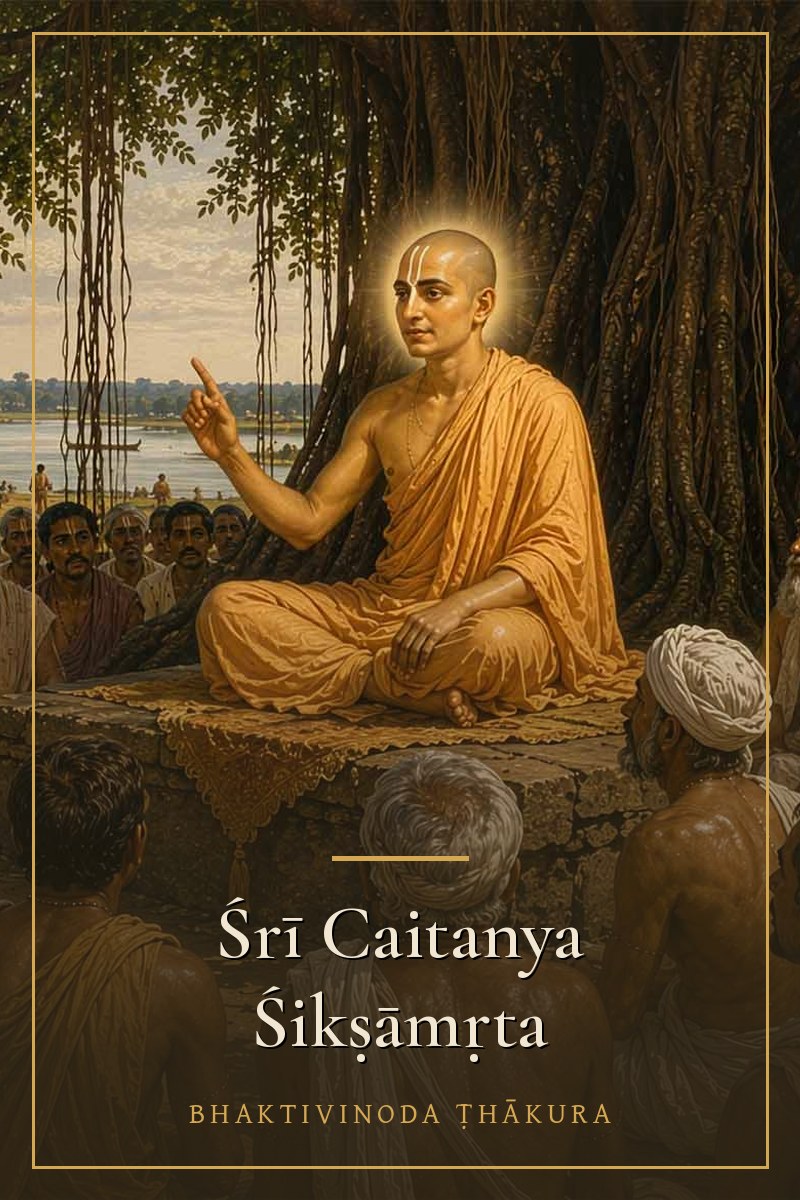
Śrī Caitanya Śikṣāmṛta
The Ambrosial Teachings of Śrī Caitanya