
Prathama Varṣa
(First Shower)
Tritīya Dhara
(Third Stream)
Kṛṣṇa, the Potencies of Kṛṣṇa, and Rasa
Kṛṣṇa, whose nature is the embodiment of sat-cit-ānanda, is the Supreme Controller. He is without beginning. He is the origin of all. In the śāstra, His name is Govinda. He is the cause of all causes. As stated in the Sanātana-śikṣā:
kṛṣṇera svarūpa-vicāra śuna sanātana
advaya-jñāna-tattve vraje vrajendra-nandana
sarva-ādi, sarvāṁśī kiśora-śekhara
cid-ānanda-deha, sarvāśraya, sarveśvara
svayaṁ-bhagavān kṛṣṇa, govinda para nāma
sei aiśvarya-pūrṇa yāṅra goloka—nitya-dhāma
O Sanātana, listen to this deliberation on Kṛṣṇa’s svarūpa. The son of the king of Vraja dwells in Vraja as the non-dual Absolute Truth. He is the origin of all, the source of all expansions, and the supreme crest-jewel of eternal youth. His fo(1)m is composed of eternity, consciousness, and bliss; He is the shelter of all and the Lord of all. Kṛṣṇa is Svayaṁ-Bhagavān, and Govinda is His supreme Name. His eternal abode is Goloka, fully endowed with all divine opulence. (Caitanya-caritāmṛta, Madhya-līlā 20.152-155) (1)
(1) goloka-nāmni nija-dhāmni tale ca tasya
devi maheśa-hari-dhāmasu teṣu teṣu
te te prabhāva-nicayā vihitāś ca yena
govindam ādi-puruṣaṁ tam ahaṁ bhajāmi
Above Devī-dhāma is Maheśa-dhāma, and above that is Hari-dhāma, and above all of them is His own abode known as Goloka. I worship Govinda, the original Person, who has provided all powers to those particular realms. (Brahma Saṁhitā 5.43)
It is through the experiences of the jīvas that realisation of the nature of the Supreme is observed. By means of the faculty of perception that the Supreme Lord has bestowed upon human beings, advanced jīvas perceive the true nature of the Supreme. The human perceptive capacity is of three kinds:
(1) the knowledge-acquiring senses associated with the gross body,
(2) the faculty of understanding associated with the subtle body or mind,
(3) the jīvātmā’s intrinsic faculty of spiritual cognition.
The five knowledge-acquiring senses are the eyes, ears, nose, tongue, and skin (touch). The external awareness obtained through them is merely material knowledge. Through mental functions such as thought, memory, meditation, and conceptualisation – each of which reflects material knowledge – there arises only material cognition and the perception of a mere reflection of consciousness (cid-ābhāsa). Hence, both of these kinds of cognitive faculties are mundane.
The experience of the reality of the inherent nature of the Supreme as pure consciousness and bliss (cidānanda) is not possible through these two faculties. Hence, without taking shelter of the ātma-vṛtti (the ātmā’s own faculty) (2), one cannot perceive the nature of the Supreme. Those human beings who attempt to perceive the nature of the Supreme while taking shelter of the material knowledge-acquiring senses, by accepting refuge in the limbs of yoga such as āsana, prāṇāyāma, dhyāna, and dhāraṇā, and by means of an externalised mind, conceive of a kind of samādhi known as paramātmā-darśana, wherein they understand the Supreme to be the ātmā of the created universe.
(2) yathā yathātmā parimṛjyate’sau
mat-puṇya-gāthā-śravaṇābhidhānaiḥ
tathā tathā paśyati vastu sūkṣmaṃ
cakṣur yathaivaṃ añjana-saṃprayuktam
Just as the ātmā is gradually cleansed by hearing and chanting My auspicious glories, so it sees subtle reality more and more clearly – just as the eye, when treated with medicinal ointment, sees with ever-greater clarity. (Śrīmad Bhāgavatam 11.14.26)
Even in this endeavour, one does not attain a fully transcendental vision. One merely gains a partial understanding by negating material knowledge. Those persons who, through a mind even more externalised than that, reject material forms etc. and imagine the nature of the Supreme as being formless and unchanging – they consider this to be brahma-darśana. But in truth, their brahma-darśana is a mere pretence (3).
(3) vācaṃ yaccha mano yaccha prāṇān yacchendriyāṇi ca
ātmānam-ātmanā yaccha na bhūyaḥ kalpase’dhvane
yo vai vāṅmanasī samyag saṁyacchen dhiyā yatiḥ
tasya vrataṁ tapo dānaṁ sravatyām ghatāmbuvat
tasmān mano-vācaḥ prāṇān nivasec chṛṇu māt parāyaṇaḥ
mad-bhakti-yuktayā buddhyā tataḥ parisamāpyate
Restrain speech, restrain the mind, restrain the prāṇa and the senses likewise; restrain the self by the self – then you shall no longer wander on the path. One who properly restrains speech and mind together through wise intelligence – for him all vows, austerities and charity become fully embodied in that restraint. Therefore, with a mind fixed on Me, hear Me as the supreme goal; united with intelligence devoted to Me, one is delivered from wandering. (Śrīmad Bhāgavatam 11.16.42-44)
Therefore, the Lord told Sanātana:
jñāna, yoga, bhakti tina sādhanera vase
brahma, ātmā, bhagavān tri-vidha prakāśe
According to the three types of sādhana – jñāna, yoga, and bhakti – He manifests in three ways as Brahman, Paramātmā, and Bhagavān. (Caitanya-caritāmṛta, Madhya-līlā 20.157)
He has further said:
mukhya-gauṇa-vṛtti, kiṁvā anvaya-vyatireke
vedera pratijñā kebala kahaye kṛṣṇake
Whether one interprets the Vedas according to their direct meaning, their indirect meaning, or through the logical methods of affirmation and negation, the Vedas ultimately proclaim only Kṛṣṇa (Caitanya-caritāmṛta, Madhya-līlā 20.146)
The conclusion of the topic is this – when the jīva, in the capacity of a seer, desires to behold the Supreme, then he sees that form of the Lord which is the object of vision corresponding to the adhikāra, or qualification, from which he observes. Through karma-yoga, Paramātmā; through jñāna–yoga, Brahman; and through bhakti-yoga, Bhagavān are described in relation to us.
Those scholars who have seen the truth refer to that Reality whose essential nature is non-dual consciousness (advaya-jñāna-svarūpa-tattva) simply as tattva. (4) That non-dual conscious Reality is perceived differently through the various instruments appropriate to each respective qualification.
(4) vadanti tat tattva-vidas tattvaṁ yaj jñānam advayam
brahmeti paramātmeti bhagavān iti śabdyate
The seers that know the Absolute Truth call this non-dual substance Brahman, Paramātmā or Bhagavān. (Śrīmad Bhāgavatam 1.2.11)
Brahman, Paramātmā, and Bhagavān are, in truth, one and the same Reality. Whatever form and extent a person is able to perceive, that alone he sees, and having seen it, he concludes it to be the highest.
That Bhagavān is indeed Śrī Kṛṣṇa. Those who, considering Kṛṣṇa to be merely a human being and possessed of enjoyments like those of ordinary men, neglect Him, exhibit a particular narrowness in their understanding of Reality.
In regards to the fact that Kṛṣṇa is Svayaṁ-Bhagavān, Mahāprabhu instructed Sanātana, drawing upon the essential purport of śāstras such as the Śrīmad Bhāgavatam, as follows:
bhakte bhagavānera anubhava—pūrṇa-rūpa
ekai vigrahe tāṅra ananta svarūpa
svayaṁ-rūpa, tad-ekātma-rūpa, āveśa nāma
prathamei tina-rūpe rahe bhagavān
‘svayaṁ-rūpa’, ‘svayaṁ-prakāśa’—dui-rūpe sphūrti
svayaṁ-rūpe eka kṛṣṇa vraje gopa-mūrti
‘prābhava’, ‘vaibhava’-rūpe dvividha prakāśe
To the devotee, the realisation of Bhagavān is in His complete form. Within a single divine form are His infinite manifestations. Bhagavān exists primarily in three forms known as Svayaṁ-Rūpa, Tad-ekātma-rūpa, and Āveśa. The category of Svayaṁ-rūpa manifests in two ways – Svayaṁ-Rūpa and Svayaṁ-Prakāśa. In His Svayaṁ-Rūpa, Kṛṣṇa alone exists in Vraja in the form of a cowherd boy. His manifestations are of two kinds – Prābhava and Vaibhava. (Caitanya-caritāmṛta, Madhya-līlā 20.164–67)
avatāra haya kṛṣṇera ṣaḍ-vidha prakāra
puruṣāvatāra eka, līlāvatāra āra
guṇāvatāra, āra manvantarāvatāra
yugāvatāra, āra śaktyāveśāvatāra
The avatāras of Kṛṣṇa are of six kinds – Puruṣāvatāra, and then Līlāvatāra; Guṇāvatāra and Manvantarāvatāra, Yugāvatāra, and Śaktyāveśāvatāra. (Caitanya-caritāmṛta, Madhya-līlā 20.245–46)
brahmā-śiva ājñākārī bhakta-avatāra
pālanārthe viṣṇu kṛṣṇera svarūpa-ākāra
Brahmā and Śiva are obedient bhakta-avatāras. For the purpose of maintenance, Viṣṇu bears the Svarūpa-form of Kṛṣṇa. (Caitanya-caritāmṛta, Madhya-līlā 20.317)
Complete aiśvarya (sovereignty), complete vīrya (prowess), complete yaśaḥ (fame), complete śrī (beauty), complete jñāna (knowledge), and complete vairāgya (renunciation) –these six are opulences. The person endowed with all of these is Bhagavān. Kṛṣṇa alone is Svayaṁ-Bhagavān, because in Him by nature alone is the supreme manifestation of all divinity. There is none higher than Kṛṣṇa, nor anyone equal to Him. Kṛṣṇa, in His own intrinsic nature, resides eternally in Goloka.The Tad-ekātma Puruṣas act according to Kṛṣṇa’s will. Mahā-Viṣṇu is Kṛṣṇa’s first Puruṣāvatāra. He reclines upon the Kāraṇa Ocean. His portions are the two Puruṣas – Garbhodaśāyī and Kṣīrodaśāyī. The avatāras such as Rāma and Nṛsiṁha are but partial portions (aṁśa-kalā) of the Puruṣa. But Kṛṣṇa is Svayaṁ-Bhagavān – the very source of the Puruṣāvatāras. By the power of His acintya-śakti, Kṛṣṇa, while remaining supreme over all, simultaneously descends in the form of Vrajendra-nandana.
The Brahman spoken of in the Upaniṣads is the bodily effulgence of Kṛṣṇa. (5)
(5) yasya prabhā prabhavato jagad-aṇḍa-koṭi-
koṭiṣv aśeṣa-vasudhādi vibhūti-bhinnam
tad brahma niṣkalam anantam aśeṣa-bhūtaṁ
govindam ādi-puruṣaṁ tam ahaṁ bhajāmi
I worship Govinda, the original Person, from whose radiance the non-differentiated Brahman spoken of by the Upaniṣads originates, and is distinct from the earth and other opulences found within millions of universes, and is perceived as the undivided, infinite, unlimited Reality. (Brahma Saṁhitā 5.40)
The Paramātmā mentioned in the Yoga-śāstras and the Vedas is but one portion of Kṛṣṇa (6). There is abundant śāstrika evidence for both these statements, and the arguments of mere logic and dialectics cannot easily comprehend this. Just as light from the sun pervades the solar world in all directions, so too from Kṛṣṇa – the sun of pure consciousness and bliss, possessed of all powers and transcendental in nature – His infinite rays pervade everywhere in the form of the all-pervading Brahman, and have appeared to thinkers who contemplate only the distinguishing attributes, as a formless, immutable Reality. The portion of Kṛṣṇa that enters the material creation is sought by the yogīs and called Paramātmā. The formless, immutable qualities, which are but transformations of the material mode of goodness (sattva–guṇa), have become the objects of worship for those scholars of limited vision. Fearing that worship of persons or qualities might overcome them, men who pride themselves as scholars of this partial understanding take refuge in the formless and immutable, and in the end are deprived of the treasure of prema.
(6) kṛṣṇam enam avehi tvam ātmānam akhilātmanām
jagad-dhitāya so ’py atra dehīvābhāti māyayā
Know this Kṛṣṇa to be the Ātmā of all ātmās. For the benefit of the universe, He too appears here, by māyā, as if a bearer of a material body. (Śrīmad Bhāgavatam 10.14.55)
It is from evil impressions (asat-saṁskāra) alone that such a distortion of this pure, inherent dharma of the jīva takes place. Those in whose hearts the greatness of Kṛṣṇa and the beauty of Kṛṣṇa arise become delivered from notions of exclusion such as impersonalism and behold the transcendental realm. By the good fortune of the jīva, such infinite happiness is attained.
As a result of misfortune, an intelligence bound by mere material science is unable to extend into the transcendental domain. Although Kṛṣṇa is the beginningless and endless Lord of Goloka, the supreme abode in transcendental time, yet by the operation of His inconceivable potency, He independently and by His own free will descends into the earthly world, bringing with Himself the Vraja of Goloka, and always moves about in His pure and fully differentiated nature. Living beings become aware of these pastimes of Kṛṣṇa through the jīva’s pure samādhi. (7) They are not perceived by the fleshly eyes and the like. At times, although Kṛṣṇa manifests before the physical eyes by His own potency, He nevertheless remains virtually unmanifest. Kṛṣṇa’s līlā is eternal. It is not interrupted by material space and time. It can be seen only through the devotee’s spiritually purified eye of bhakti, and it is meditated upon only in a mind imbued with bhakti. (8)
(7) atho mahā-bhāga bhavān amogha-dṛk
śuci-śravāḥ satya-rato dhṛta-vrataḥ
urukramasyākhila-bandha-muktaye
samādhinānusmara tad-viceṣṭitam
Therefore, O highly blessed one, endowed with unfailing vision, purified hearing, devotion to truth, and steadfast vows, meditate in samādhi upon the deeds of Urukrama, for they free one from all bondage. (Śrīmad Bhāgavatam 1.5.13)
(8) bhakti-yogena manasi samyak praṇihite ’male
apaśyat puruṣaṁ pūrṇaṁ māyāṁ ca tad-apāśrayām
yayā sammohito jīva ātmānaṁ tri-guṇātmakam
paro ’pi manute ’narthaṁ tat-kṛtaṁ cābhipadyate
anarthopaśamaṁ sākṣād bhakti-yogam adhokṣaje
lokasyājānato vidvāṁś cakre sātvata-saṁhitām
By bhakti-yoga, when the mind had been properly fixed and made spotless, he saw the Complete Puruṣa and also Māyā, which stands dependent upon Him. By that Māyā, the jīva, though transcendental, becomes bewildered, identifies himself with the three guṇas, regards himself as a product of material nature, and thereby undergoes the miseries arising from that misconception. The direct means for the cessation of these anarthas is bhakti-yoga unto Adhokṣaja. Therefore, the wise sage composed the Sātvata-saṁhitā for people who are unaware of this truth. (Śrīmad Bhāgavatam 1.7.4-6)
yasyāṁ vai śrūyamāṇāyāṁ kṛṣṇe parama-pūruṣe
bhaktir utpadyate puṁsaḥ śoka-moha-bhayāpahā
By hearing this Bhāgavata, bhakti arises in a person toward Kṛṣṇa, the Supreme Person, and it destroys lamentation, illusion, and fear. (Śrīmad Bhāgavatam 1.7.7)
So long as the mind rushes toward that Supreme Reality with the pride of material knowledge and science, that Reality remains, as it were, situated far away. But when one, with a heart humbler than a blade of grass, cries out for Kṛṣṇa in deep longing, then fortunate persons directly perceive Him and experience boundless joy. By good fortune, if faith arises and one does not remain deluded by material pride, one does not become an offender to the Holy Name. In the cultivation of kṛṣṇa-bhakti, caste, social class, material learning, beauty, strength, the power derived from material science, high position, wealth, kingdom, and the like – none of these have any effect. For those who are bound by such attachments, and for those who are proud of caste distinctions, kṛṣṇa-tattva remains naturally far distant. When all these reasons are duly considered, the cause of the present-day contempt for kṛṣṇa-tattva shall be readily understood. (9)
(9) śriyā vibhūtyābhijanena vidyayā
tyāgena rūpeṇa balena karmaṇā
jāta-smayenāndha-dhiyaḥ saheśvarān
sato ’vamanyanti hari-priyān khalāḥ
Conceited and blinded by wealth, opulence, high birth, learning, renunciation, beauty, strength, and activity, wicked persons disrespect the devotees of Kṛṣṇa, who are equal to the Lord Himself. (Śrīmad Bhāgavatam 11.5.9)
The misfortune of material science is this – it seeks to know all realities that lie beyond its own jurisdiction. It has no qualification for transcendental Reality, yet nevertheless it rushes toward it shamelessly and becomes bound to extremely insignificant conclusions. Ultimately, it becomes distorted itself and comes to a halt. When humility born of saintly association arises in the jīva, Kṛṣṇa’s grace descends. Only thereby does one’s qualification for transcendental Reality take birth. By the power of material reasoning alone, no transcendental knowledge can ever be gained. (10)
(10) athāpi te deva padāmbuja-dvaya-
prasāda-leśānugṛhīta eva hi
jānāti tattvaṁ bhagavan-mahimno
na cānya eko ’pi ciraṁ vicinvan
Even so, O Lord, only one who has been blessed by even a slight trace of mercy from Your two lotus feet is able to know the truth of the greatness of the Supreme Lord; no one else, even after long deliberation, can know it. (Śrīmad Bhāgavatam 10.14.29)
The potency of Kṛṣṇa is infinite. In the infinite universe, we cannot know by our limited jīva-based knowledge where and in what manner the various potencies of the Supreme Lord are manifested. Beyond the material realm, beyond Virajā, lies Vaikuṇṭha, and above that is Goloka Vraja. In Vaikuṇṭha, all opulence is present in the form of four-armed Nārāyaṇa.(11) Kṛṣṇa is the Supreme Possessor of energy. His essential nature is accompanied by an inconceivable great potency. In many places in the śāstras, that potency is referred to as māyā. Mīyate anayā iti māyā – in this sense, māyā is that by which things are measured (or delimited); therefore māyā may be called Kṛṣṇa’s external identity.
(11) ko vetti bhūman bhagavan parātman
yogeśvarotīr bhavatas tri-lokyām
kva vā kathaṁ vā kati vā kadeti
vistārayan krīḍasi yoga-māyām
O all-pervading Lord, O Supreme Bhagavān, O Supersoul, O Lord of all mystic powers – who can ever know Your movements within the three worlds? Where, how, in how many forms, and when do You expand and play out Your Yogamāyā? (Śrīmad Bhāgavatam 10.14.21)
Without māyā, there is no means of knowing Kṛṣṇa. The knowers of Reality explain māyā itself as Kṛṣṇa’s svarūpa-śakti, and distinguish, under the divisions of parā and aparā, between cit-śakti and māyā-śakti. In truth, the parā-śakti alone is Kṛṣṇa’s one and only acintya-śakti. What is called aparā-śakti is but her shadow. The māyā that governs the material universe is that very shadow-form. (12) The māyā-śakti which is described as condemned in relation to consciousness is this shadow-form māyā. It is not the māyā which is the svarūpa-śakti.
(12) ṛte ’rthaṁ yat pratīyeta na pratīyeta cātmani
tad vidyād ātmano māyāṁ yathābhāso yathā tamaḥ
If that which appears to have some purpose, has no connection to Me, then you should understand this to be My māyā potency. It is like an appearance of light or darkness. (Śrīmad Bhāgavatam 2.9.34)
For this reason the Lord said to Sanātana:
kṛṣṇera svābhāvika tina śakti-pariṇati
cit-śakti, jīva-śakti āra māyā-śakti
Kṛṣṇa’s natural potency manifests in three transformations – cit-śakti, jīva-śakti, and māyā-śakti. (Caitanya-caritāmṛta, Madhya-līlā 20.111)
He has further said:
ananta śaktira madhye kṛṣṇera tina-śakti pradhāna
icchā-śakti, kriyā-śakti, jñāna-śakti nāma
Among Kṛṣṇa’s infinite potencies, three are foremost. They are named icchā-śakti [the potency of will], kriyā-śakti [the potency of action], and jñāna-śakti [the potency of knowledge]. (Caitanya-caritāmṛta, Madhya-līlā 20.252)
The Lord said to Sārvabhauma:
sac-cid-ānandamaya haya īśvara-svarūpa
tina aṁśe cit-śakti haya tina rūpa
ānanda-aṁśe hlādinī, sat-aṁśe sandhinī
cid-aṁśe saṁsthita yāke kṛṣṇa-jñāna māni
antaraṅgā cit-śakti, taṭasthā jīva-śakti
bahiraṅgā māyā, tine kare prema-bhakti
The nature of The Supreme is full of sat, cit, and ānanda. In three portions, the cit-śakti takes three forms. In the aspect of ānanda [bliss] is hlādinī; in the aspect of sat [existence] is sandhinī. That which is established in the aspect of cit [consciousness] is regarded as knowledge of Kṛṣṇa. The internal śakti is cit-śakti; the marginal śakti is jīva-śakti; the external potency is māyā – these three together bring about prema–bhakti. (Caitanya-caritāmṛta, Madhya-līlā 6.158-160)
The essential purport of the transformations of the various potencies is this – Kṛṣṇa’s ātma–śakti (self-potency), or svarūpa-śakti (internal potency), or parā-śakti (supreme potency), is one. That parā-śakti has three vibhāvas (manifestations), three prabhāvas (influences), and three anubhāvas (subsidiary manifestations), which have expanded as reflections of Kṛṣṇa. (13) Cit-śakti, jīva-śakti, and māyā-śakti – these are the three vibhāvas. Icchā-śakti, kriyā–śakti, and jñāna-śakti – these are the three prabhāvas. Sandhinī, hlādinī, and saṁvit – these are the three anubhāvas.
(13) yasmin viruddha-gatayo hy aniśaṁ patanti
vidyādayo vividha-śaktaya ānupūrvyāt
tad brahma viśva-bhavam ekam anantam ādyam
ānanda-mātram avikāram ahaṁ prapadye
I surrender unto that one, infinite, beginningless Brahman, the source of the universe, who is pure bliss alone and unchanging, in whom all opposed movements constantly merge, and from whom, in proper sequence, the various powers such as knowledge and others emanate. (Śrīmad Bhāgavatam 4.9.16)
Through the prabhāva in the form of icchā-śakti, from cit-śakti have manifested Goloka, Vaikuṇṭha and other pastime-abodes, names such as Kṛṣṇa and Govinda, the forms of the Deity such as two-armed, four-armed, and multi-armed, the līlās along with their associates in Goloka, Vṛndāvana, Vaikuṇṭha and other dhāmas, and qualities such as mercy, generosity, forgiveness, etc., have become manifest.
Through the prabhāva of jñāna-śakti, the opulence pertaining to Vaikuṇṭha, and through cit–śakti, sweetness (mādhurya), beauty (saundarya), and other qualities have arisen. Apart from Kṛṣṇa, icchā-śakti resides in no one else. The presiding Deity of jñāna-śakti is the Vāsudeva manifestation. The presiding Deity of kriyā-śakti is the Baladeva-Saṅkarṣaṇa manifestation. Within jīva-śakti, which is the marginal potency (taṭastha-śakti), through the prabhāvas of will, knowledge, and action there have arisen eternal associates (nitya-pārṣadas), the class of authorised Devas, and also humans, Daityas, and Rākṣasas.
All the manifestations of Kṛṣṇa’s activities as experienced effects are due to the power of His own kriyā-śakti. In cit-śakti, the diverse aspects of sandhinī, saṁvit, and hlādinī, becoming combined, produce the accomplishment of the supreme purpose in the form of prema–līlā, wherein direct and indirect states are realised.
As stated in the teachings to Sanātana:
yadyapi asṛjya nitya cit-śakti-vilāsa
tathāpi saṅkarṣaṇa-icchāyā tāṅhāra prakāśa
Although the pastimes of the cit-śakti are eternal and not created, nevertheless they are manifested by His will of Saṅkarṣaṇa. (Caitanya-caritāmṛta, Madhya-līlā 20.257)
Another name for the chāyā-śakti (shadow-potency) is jaḍā-prakṛti (inert material nature); concerning it the following has been said:
māyā-dvāre sṛje tiṅho brahmāṇḍera gaṇa
jaḍa-rūpā prakṛti neha brahmāṇḍera kāraṇa
jaḍa haite sṛṣṭi neha īśvara-śakti binā
tāhātei saṅkarṣaṇa kare śaktira ādhāne
īśvarera śakte sṛṣṭi kareya prakṛti
loha yena agni-śakte pāya dāha-śakti
Through māyā He creates the multitude of universes. Material nature is not itself the cause of the universe. There is no creation from matter without the energy of the Lord; therefore Saṅkarṣaṇa establishes the potency there. By the power of the Lord, material nature produces creation. Just as iron acquires the power of burning through contact with fire. (Caitanya-caritāmṛta, Madhya-līlā 20.259-261)
The name of Kṛṣṇa’s kriyā-śakti is saṅkarṣaṇa-śakti. The perishable transformation of the māyā-śakti is the inert material world. In the Fourth Stream, something further shall be elaborated concerning the taṭastha–śakti, or jīva-śakti, as it relates to the jīvas.
Rasa-tattva (the principle of divine mellows) is Śrī Kṛṣṇa Himself. This has been declared in the Vedas. In the First Stream of the Seventh Shower, rasa-tattva will be examined, whereby one will directly experience what rasa actually is.
Speech is material – therefore whatever speech expresses, even if supported by all kinds of instruments, remains material or materially conditioned. If the reader approaches the subject with genuine faith, then aprākṛta-rasa shall arise within his purified consciousness. This comes only as a result of holy association and good fortune. If one proceeds through argumentation alone, it shall not arise. In bad company, prākṛta-rasa (mundane mellows), in the form of Sahajiyāism, causes the seeker to fall down. Rasa-tattva must be experienced with special care.
Śrī Kṛṣṇa, endowed with sixty-four transcendental qualities, is Himself undivided rasa. (14) Among those sixty-four qualities, fifty reside in the jīvas as mere drops. Those fifty qualities, in somewhat greater measure, together with five additional qualities, are found in such Devas as Śiva, Brahmā, Gaṇeśa, Sūrya, etc. Though they are but partial manifestations, they too are designated by the title ‘īśvara.’ Those fifty qualities are found in full form, and the five additional qualities are also found in full form in Nārāyaṇa, Viṣṇu, and Their avatāras. The sixty-four qualities of viṣṇu-tattva, together with four further supremely transcendental and extraordinary qualities, are all present in Kṛṣṇa. For this reason, Kṛṣṇa alone is the Supreme Controller of all, the omnipotent, and the repository of all rasas. All the varieties that exist within the svarūpa-śakti become embodied and serve as the ingredients of Kṛṣṇa’s śānta, dāsya, vātsalya, sakhya, and madhura rasas.
(14) ayaṃ netā sura-mayāṅgaḥ sarva-lakṣaṇānvitaḥ
ruciras tejasā yukto balavān vayasānvitaḥ
vividha-adbhuta-bhāṣābhis satya-vākyaḥ priyaṃvadaḥ
vāgmi supāṇigaḥ buddhimān pratibhānvitaḥ
vidagdha-catura-dakṣaḥ kṛtajñaḥ sudṛḍha-vrataḥ
deśa-kāla-supātra-jñaḥ śāstra-cakṣuḥ śuci-vaṃśaḥ
sthiro dātā kṣamā-śīlo gambhīro dhṛtimān samaḥ
vadānyaḥ dhārmikaḥ śūraḥ karuṇo māna-pradāyakaḥ
dakṣiṇo vinayī hrīmān śaraṇāgata-pālakaḥ
sukhī bhakta-suhṛt prema-vaśaḥ sarva-bandhuhā
pratāpī kīrtimān rakta-lokaḥ sādhu-samāśrayaḥ
nārī-gaṇa-mano-hārī sarvārādhyaḥ samṛddhimān
varīyān īśvara-śreṣṭhaḥ guṇās tān kīrtitān
samudrā iva pāṃśavaḥ sudurgrāhyā harer guṇāḥ
jīvanti te vasanty api bindu-bindutayā kvacit
paripūrṇatayā bhāti tair eva puruṣottamaḥ
atha pañca-guṇā ye tu sura-śreṇeṣu giriśādiṣu
sadā svarūpa-saṃprāptaḥ sarvajño nitya-nūtanaḥ
sac-cid-ānanda-sāndrāṅgaḥ cid-ānanda-ghana-ākṛtiḥ
sva-vaśaḥ akhila-siddhaḥ syāt sarva-siddhi-niṣevitaḥ
He is the leader, possessing a divine form endowed with all auspicious characteristics. He is beautiful, endowed with splendour and strength, and possessed of youth. He speaks in many wondrous languages; His words are truthful and sweet. He is eloquent, skilful, intelligent, and endowed with sharp insight. He is expert, clever, dexterous, grateful, firmly resolute, and knows the proper person, time, and place. He has the eye of scripture and belongs to a pure lineage. He is steady, charitable, forgiving, grave, self-controlled, and equal-minded. He is generous, righteous, heroic, and compassionate, and grants respect to others. He is gentle, humble, modest, the protector of those who surrender to Him. He is happy, the friend of devotees, controlled by love, and the well-wisher of all beings. He is majestic and famous, beloved of all people, the shelter of saints, attractive to all women, worshipable by all, and full of prosperity. Even these qualities of Hari are extremely difficult to grasp – like trying to capture an ocean in grains of sand. Even if they are described, they appear only partially, as if in drops. Yet even in such partial manifestation, the Supreme Person is fully present. Beyond these are five supreme qualities found in deities such as Śiva and the gods. He is always situated in His own eternal form, all-knowing and ever fresh. His body is condensed existence, consciousness and bliss, and He is the concentrated form of cit and ānanda. He is fully independent, master of all perfections, and served by all perfections. (Śrī Bhakti-rasāmṛta-sindhu 2.1.23-30)
atha pañca-guṇā ye syur aṁśena giriśādiṣu
sadā svarūpa-samprāptaḥ sarva-jño nitya-nūtanaḥ
sac-cid-ānanda-sāndrāṅgaḥ sarva-siddhi-niṣevitaḥ
Now, the five qualities that appear in partial manifestation in Śiva and others are as follows – He is always situated in His own nature, all-knowing, and ever fresh. His body is dense existence–consciousness–bliss, and He is served by all perfections. (Śrī Bhakti-rasāmṛta-sindhu 2.1.37-38)
athocyante guṇāḥ pañca ye lakṣmīśādi-vartinaḥ
avicintya-mahā-śaktiḥ koṭi-brahmāṇḍa-vigrahaḥ
avatārāvalī-bījaṁ hatāri-gati-dāyakaḥ
ātmārāma-gaṇākarṣīty amī kṛṣṇe kilādbhutāḥ
sarvādbhuta-camatkāra-līlā-kallola-vāridhiḥ
atulya-madhura-prema-maṇḍita-priya-maṇḍalaḥ
tri-jagan-mānasākarṣi-muralī-kala-kūjitaḥ
asamānordhva-rūpa-śrī-vismāpita-carācaraḥ
līlā premṇā priyādhikyaṁ mādhuryaṁ veṇu-rūpayoḥ
ity asādhāraṇaṁ proktaṁ govindasya catuṣṭayam
evaṁ guṇāś catur-bhedāś catuḥ-ṣaṣṭir udāhṛtāḥ
Now are described five qualities which are also present in Lakṣmī and other divine beings – inconceivable great potency, having forms extending through millions of universes, being the seed of all avatāras, granting liberation or destination to those who destroy their enemies, and attracting even the self-satisfied liberated souls—these are indeed wonderful qualities of Kṛṣṇa. He is an ocean of waves of all astonishing and wondrous pastimes. He is surrounded by beloved associates adorned with incomparable sweet love. His flute-song attracts the minds of the three worlds. His unsurpassed beauty astonishes all moving and non-moving beings. His pastimes, His love, the superiority of His beloved associates, and the sweetness of His flute are supremely excellent. Thus these extraordinary qualities of Govinda are described. In this way, the qualities are divided into four categories, and sixty-four qualities are enumerated. (Śrī Bhakti-rasāmṛta-sindhu 2.1.39-44)
Rādhā Ṭhākurāṇī, who is the very essence of the hlādinī-śakti, is the foremost of all. Although this rasa has its eternal abode in Goloka Vraja, Kṛṣṇa’s shadow-energy, Yogamāyā, the cit-śakti, manifests that same rasa in its entirety in the earthly Vraja. Those whose intelligence has not been trained to transcend the material qualities will not be able to ascertain or experience this boundless rasa-tattva. Consequently, they will neglect vraja-rasa through material understanding. Therefore the Śrīmad Bhāgavata declares that those who, with faith, either describe or hear vraja-rasa, very soon attain prema in the form of parā–bhakti, and gain liberation from the heart-disease born of inert matter. (15) This is the ultimate teaching of Mahāprabhu.
(15) vikrīḍitaṁ vraja-vadhūbhir idaṁ ca viṣṇoḥ
śraddhānvito’nuśṛṇuyād atha varṇayed yaḥ
bhaktiṁ parāṁ bhagavati pratilabhya kāmaṁ
hṛd-rogam āśv apahinoty acireṇa dhīraḥ
If a self-controlled person listens with faith to the confidential pastimes of Viṣṇu with the damsels of Vraja, from the mouth of Śrī Guru and glorifies them at every second, then he immediately obtains transcendental devotion towards the Supreme Lord and becomes capable of distancing himself from the heart disease of lust without delay. (Śrīmad Bhāgavatam 10.33.39)
On The Same Subject
Related Articles and Books
Other works by Bhaktivinoda Ṭhākura
Books
Articles
From Other Vaiṣṇava Authors
Further Reading from Rupanuga Bhajan Ashram
Selected works by Vaiṣṇava authors from our sister websites
Articles
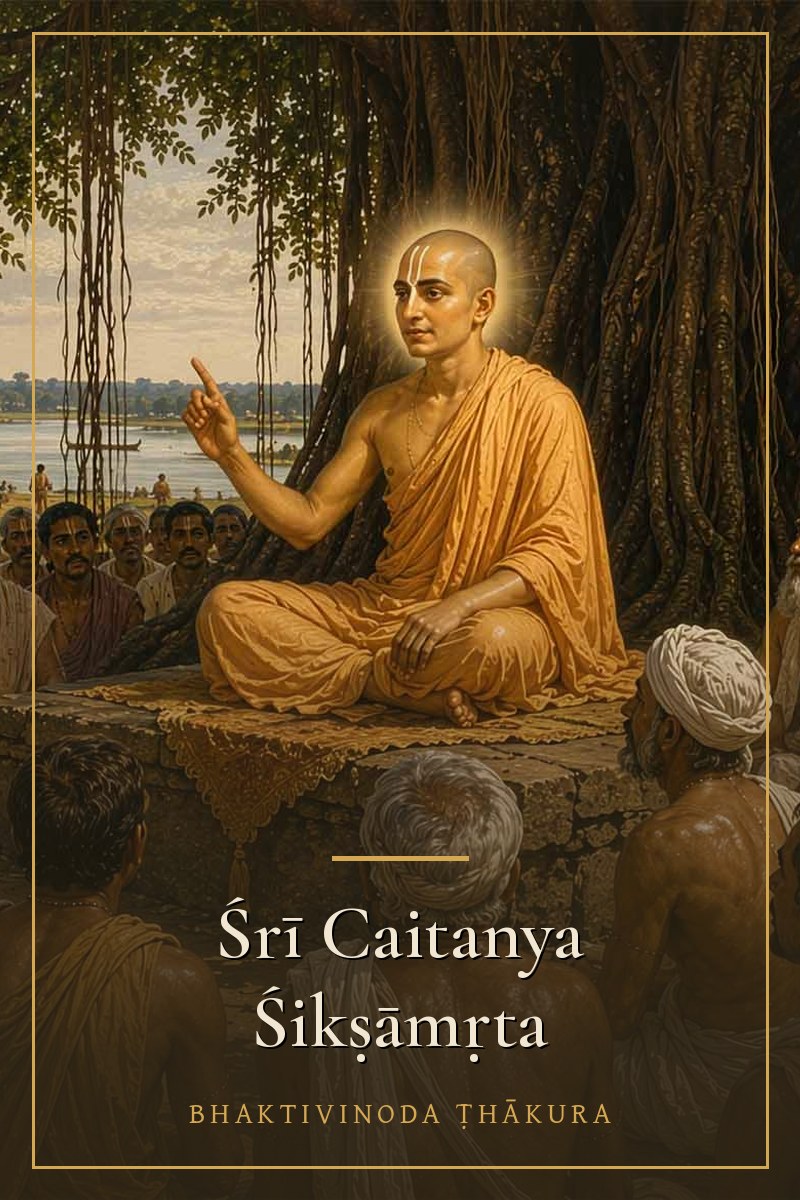
Śrī Caitanya Śikṣāmṛta
The Ambrosial Teachings of Śrī Caitanya