
Dvitīya-Vṛṣṭi
(Second Shower)
Gauṇa-vidhi-vicāra
(An Analysis of Secondary Rules)
Prathama Dhārā
(First Stream)
Gauṇa-vidhira Vibhāga
(The Classification of Secondary Rules)
It has been demonstrated in the First Shower that bhakti is the abhidheya of the śāstra, in other words, the sole means prescribed by śāstra for attaining prema, the upeya, or goal of the jīva. It has also been examined that karma and jñāna are not directly, or primarily, the abhidheya, although they have some degree of utility; they are designated as secondary means, whereas the primary means consist of the principal injunctions, beginning with śravaṇa (hearing) etc. Although secondary, karma and jñāna must also be referred to as abhidheya in the case of the jīva bound by matter. (1)
(1) yogās trayo mayā proktā nṝṇāṁ śreyo-vidhitsayā
jñānaṁ karma ca bhaktiś ca nopāyo ’nyo ’sti kutracit
Three paths have been taught by Me for the benefit of human beings who desire the highest good – jñāna, karma and bhakti. There is no other means anywhere. (Śrīmad Bhāgavatam 11.20.6)
Jñāna and karma are secondary abhidheya, while bhakti is the primary abhidheya. Jñāna and karma, functioning as means, cultivate bhakti, and bhakti in turn cultivates prema. This relationship shall be discussed progressively. If the body, mind and society can be organised in a manner favourable to bhakti, then karma and jñāna may be considered abhidheya. Otherwise, one can hear in the śāstra strong condemnation of the fault of external orientation (bahirmukhatā-doṣa) associated with those very forms of karma and jñāna. First, we shall explain the scope of the secondary injunctions (gauṇa-vidhi) and then proceed to the primary conclusion.
Secondary injunctions are of three kinds:
(1) jana-niṣṭha-vidhi (regulations concerning the individual)
(2) samāja-niṣṭha-vidhi (regulations concerning society)
(3) paraloka-niṣṭha-vidhi (regulations concerning the next world)
Jana-niṣṭha-vidhi is of two kinds, namely śarīra-niṣṭha-vidhi (regulations for the body) and mano-niṣṭha-vidhi (regulations for the mind). All the arrangements made with the intention that the human body may be nourished and remain in comfort – the totality of such arrangements is called śarīra-niṣṭha-vidhi. (2) All manner of regulations such as moderation in drinking, moderation in eating, moderation in sleep, physical exercise etc, as well as the various treatments prescribed in the Āyurveda-śāstra when one falls ill – all of these constitute śarīra-niṣṭha-vidhi. Without observing śarīra-niṣṭha-vidhi, human beings cannot comfortably maintain the course of their lives.
(2) nātyaśnata stu yogo’sti na caikāntam anaśnataḥ
na cāti svapna-śīlasya jāgrato naiva cārjuna
yuktāhāra-vihārasya yukta-ceṣṭasya karmasu
yukta-svapnāvabodhasya yogo bhavati duḥkha-hā
yadā viniyataṁ cittam ātmany-evāvatiṣṭhate
nispṛhaḥ sarva-kāmebhyo yukta ity-uchyate tadā
One cannot practice yoga by eating too much or too little, nor sleeping too much or too little, O Arjuna. Yoga destroys the suffering of one who is moderate in eating and sleeping, who performs all activities in a regulated manner and is well balanced in sleeping and waking. When the steady mind is fixed exclusively upon the self, then one becomes free from all material desires – such a person is said to be situated in yoga. (Bhagavad-gītā 6.16-18)
sarva-bhūta-stham ātmānaṁ sarva-bhūtāni cātmani
īkṣate yoga-yuktātmā sarvatra sama-darśanaḥ
One who is connected to the Supreme sees all things equally and perceives the Supreme in all living beings and all beings within the Supreme. (Bhagavad-gītā 6.29)
Without observing mano-niṣṭha-vidhi, the mind’s power of perception, power of retention, imagination, power of conception, and power of discrimination cannot become properly developed and competent to perform their respective functions. Progress in science, art, and similar fields also cannot occur. Darkness in the form of the mind’s negative impressions (ku–saṁskāra) is not dispelled. Pure knowledge regarding objects of the senses cannot be obtained. The intellect cannot be rescued from material thinking and engaged in thought of the Supreme Lord. Ultimately, thoughts of sin and an atheistic mentality continually keep the mind under their sway, reducing human beings to the level of animals. Hence, rules governing social conduct (jana-niṣṭhā-vidhi) are absolutely necessary for making human life successful.
Human beings live bound together in society, and with the intention of elevating society and rendering it free from sin, they establish the injunctions of social discipline. Among the injunctions of samāja-niṣṭha, the law of marriage is a most excellent rule. Had the institution of marriage not existed, human society could not have risen to such a height of advancement. (3) Human beings would have wandered about at will, after the manner of beasts. In certain countries there was at first no institution of marriage. It was only after many social disturbances had arisen in those lands that the institution of marriage came to be established. Renouncing licentiousness, a man takes a woman with the Supreme Lord as witness and with the consent of all, thereby laying the foundation of household life – this is called marriage. When sons and daughters are born, he nurtures and educates them and provides means for their livelihood. The present members of the household world establish the injunctions of social progress through such acts as fostering a spirit of brotherhood with one another, relieving the distress of others, earning one’s livelihood by righteous means, always upholding truth, suppressing falsehood, and so forth.
Social discipline (samāja-niṣṭha) is the foremost dharma of humankind. In every country and at every time, the working of this dharma is seen among human beings. In whatever country the social advancement and civilisational prosperity of the people is greater, in that country the laws of social discipline are proportionately more mature and deep-rooted. It is universally acknowledged that among all the peoples of the world, the Āryan race is foremost in social advancement and civilisation.
(3) na gṛhaṁ gṛham ity āhur gṛhiṇī gṛham ucyate
tayā hi sahitaḥ sarvān puruṣārthān samaśnute
A house alone is not a home. It is said that a wife makes a home. If one lives at home with her, indeed, one can perfect all the goals of human life. (A verse from Smṛti quoted by Mahāprabhu)
It is universally acknowledged that, among all peoples, the Āryan people have attained a higher degree of social development and civilisation. And among the various branches and sub-branches of the Āryan people, who can doubt that the Āryans of India have made the greatest advances in learning, intelligence and social development?
The fact that this branch of the Āryans has, in modern times, become weakened through old age and fallen under the subjugation of other peoples will not diminish its social prestige. If some immature person disputes their advancement and civilisation, that does not mean that the Indian branch of the Āryans will thereby actually be diminished. How greatly the social codes (samāja-niṣṭha-vidhi) in the hands of the Indian Āryan branch advanced human civilisation may be known simply by reading the Vedic dharma-śāstras. If one truly goes to the source, all sympathetic and scientific persons will acknowledge that it was at the hands of the ṛṣis that the social codes reached their highest perfection.
By scientific analysis, they divided the social codes into two parts:
(1) varṇa-vidhi (the code of social orders)
(2) āśrama-vidhi (the code of stages of life) (4)
(4) yas tvayābhihitaḥ pūrvaṁ dharmas tvad-bhakti-lakṣaṇaḥ
varṇāśramācāravatāṁ sarveṣāṁ dvi-padām api
You previously described that dharma characterised by bhakti to You for all human beings who follow the practices of varṇāśrama. (Śrīmad Bhāgavatam 11.17.1)
For human beings established in society there are two kinds of conditions, namely (1) svabhāva (innate nature) and (2) avasthāna (positional status).
Svabhāva arises from the nature of an individual (jana-niṣṭha dharma), and avasthāna from the nature of society (samāja-niṣṭha dharma). When one becomes social, one’s individual dharma does not perish; rather, it is nourished through social refinement. According to svabhāva, varṇa-vidhi was established, and according to avasthāna, āśrama-vidhi was prescribed. The physical and mental faculties of a human being, through gradual and progressive cultivation, attain a stable condition. That tendency which, in that condition, establishes its dominance over all other tendencies – that tendency constitutes the svabhāva of that human being.
Svabhāva is of four kinds, namely, brāhma-svabhāva (the nature of a brāhmaṇa), kṣatra–svabhāva (the nature of a kṣatriya), vaiśya-svabhāva (the nature of a vaiśya), and śūdra–svabhāva (the nature of a śūdra). These four svabhāvas arise according to the superior tendencies of the human being. Through a succession of base tendencies, a person develops antyaja-svabhāva (the nature of an outcaste). There is no other way but to renounce antyaja-svabhāva. (5)
(5) aśaucam anṛtaṁ steyaṁ nāstikyaṁ śuṣka-vigrahaḥ
kāmaḥ krodhaś ca tarṣaś casa bhāvo ’ntyāvasāyinām
Impurity, falsehood, theft, atheism, futile quarrelling, lust, anger and greed are the characteristics of those who live as outcastes. (Śrīmad Bhāgavatam 11.17.20)
From birth until the time of the rise of predominant tendencies, the seed, sprout, and tree of those strong propensities are produced and nourished in accordance with one’s association and practice. The compilers of śāstra have written that one’s natural disposition arises according to one’s past karma. Whatever family one is born into, the hereditary nature of that lineage shall become manifest from childhood onward as a quality derived from association; thereafter, through education and other associations, some improvement or deterioration shall occur – this is natural. It is required that a child born of one of śūdra nature shall be of śūdra nature, and that a child born of one of brāhmaṇa nature shall be of a brāhmaṇa’s disposition. Yet this shall not always be the case without exception – such is not the rule. Thus, the compilers of śāstra employed the system of saṁskāras with the intention of determining varṇa by ascertaining one’s natural disposition. The system of saṁskāras has been transformed over time. The country has declined because those rituals and regulations that determine one’s varṇa have, for the time being, fallen into disuse. (6) There can be no doubt that the laws of varṇa are the true social system.
(6) yasya yal lakṣaṇaṁ proktaṁ puṁso varṇābhivyañjakam
yad anyatrāpi dṛśyeta tat tenaiva vinirdiśet
Whatever characteristics are said to distinguish a person’s varṇa, if those characteristics are seen in someone elsewhere, that person should be designated accordingly. (Śrīmad Bhāgavatam 7.11.35)
According to the scientific perspective, there are four stages of life:
(1) brahmacarya
(2) gārhasthya,
(3) vānaprastha
(4) sannyāsa
(1) Those who pursue education and travel throughout the country before marriage – they are brahmacārīs.
(2) Those who, having married, remain engaged in household life – they are gṛhasthas.
(3) Those who, upon advancing in age, retire from active duties and dwell in solitude – they are vānaprasthas.
(4) Those who, having renounced all the bonds of household life, wander freely – they are sannyāsīs.
The system of dharma established by considering the relationship between the various varṇas and āśramas is called varṇāśrama-dharma. This dharma is the social code of the Indian Āryan branch. That country which lacks this code cannot be said to be a civilised and advanced country. In brief, the subject has been touched upon here; a thorough examination of it shall be undertaken in the Third Stream.
On The Same Subject
Related Articles and Books
Other works by Bhaktivinoda Ṭhākura
Books
Articles
From Other Vaiṣṇava Authors
Further Reading from Rupanuga Bhajan Ashram
Selected works by Vaiṣṇava authors from our sister websites
Articles
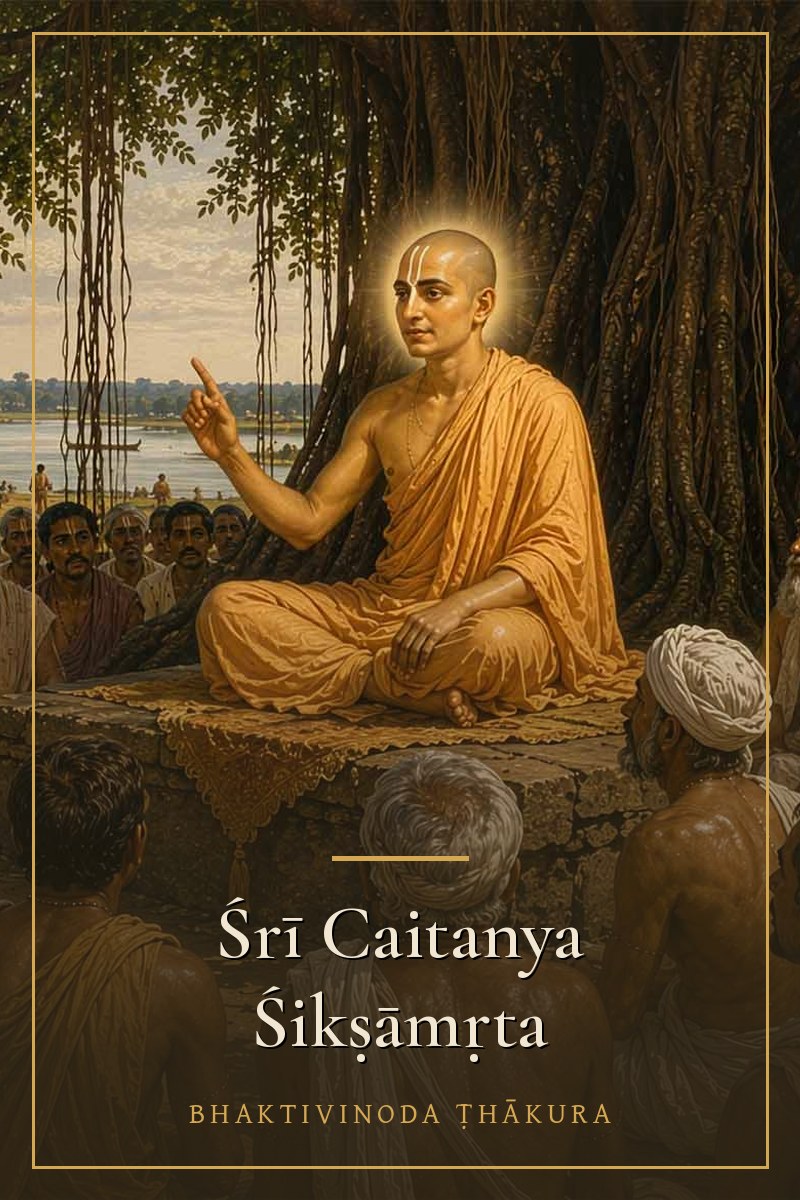
Śrī Caitanya Śikṣāmṛta
The Ambrosial Teachings of Śrī Caitanya
In This Book
- Introduction to First Edition (1886)
- Introduction to Second Edition (1906)
- First Shower – First Stream
- First Shower – Second Stream
- First Shower – Third Stream
- First Shower – Fourth Stream
- First Shower – Fifth Stream
- First Shower – Sixth Stream
- First Shower – Seventh Stream
- Second Shower – First Stream
- Second Shower – Second Stream
- Second Shower – Third Stream