
Dvitīya-Vṛṣṭi
(Second Shower)
Dvitīya Dhārā
(Second Stream)
Puṇya-karma
(Virtuous Activities)
According to the rules governing the next life, the results one obtains in the afterlife can be analysed according to one’s actions. A person who performs pious activities while living in this world will attain Svarga after death. One who performs impious activities will suffer in hell. Pious activities are called puṇya, and impious activities are called pāpa. The rules for accumulating puṇya and the regulations for avoiding pāpa, when taken together, are known as the rules governing the next life.
The various types of pious activities and the duties prescribed according to varṇāśrama are being described here. In this regard, according to the differing qualifications of those who perform them, tamasika, rajasika and sattvika faith are observed. That faith is directed either towards pravṛtti (engagement in worldly activity) or nivṛtti (withdrawal from worldly activity). Kaniṣṭha-adhikārīs (those of lower qualification) adopt faith directed towards pravṛtti. Madhyama-adhikārīs (those of intermediate qualification) adopt faith directed towards both pravṛtti and nivṛtti. Uttama-adhikārīs (those of higher qualification) act solely through faith directed towards nivṛtti. (1)
(1) tri-vidhā bhavati śraddhā dehināṁ sā svabhāva-jā
sāttvikī rājasī caiva tāmasī ceti tāṁ śṛṇu
Bhagavān Śrī Kṛṣṇa replied: The faith of the embodied living beings is of three types – goodness, passion and ignorance. That faith arises from their own nature from impressions of previous lives. Please hear about this. (Bhagavad-gītā 17.2)
yajante sāttvikā devān yakṣa-rakṣāṁsi rājasāḥ
pretān bhūta-gaṇāṁś cānye yajante tāmasā janāḥ
Those in goodness worship the demigods; those in passion worship the ancestors and demoniac forces and those in ignorance worship ghosts. (Bhagavad-gītā 17.4)
Wherever regulations for the worship of many deities are prescribed, for all such activities, the worship of Bhagavān alone is prescribed for sāttvika Vaiṣṇavas. Vaiṣṇavas have no intention of enjoying sense gratification. They should accept only those activities by which they may attain a transcendental destination. (2) Work (karma) is called the means of maintaining one’s livelihood. In the Gītā, Bhagavān has established the principle concerning the acivities of the tattva-jñānīs (those who know the Absolute Truth). They should perform whatever activities are favourable to bhakti and abandon whatever activities are unfavourable to bhakti. (3)
(2) asmiḷ loke vartamānaḥ sva-dharma-stho ’naghaḥ śuciḥ
jñānaṁ viśuddham āpnoti mad-bhaktiṁ vā yadṛcchayā
Being situated in this world, one who is established in his own duty, free from sin and pure, attains pure knowledge or, by good fortune, devotion to Me. (Śrīmad Bhāgavatam 11.20.11)
na jātu kāmaḥ kāmānām upabhogena śāṁyati
haviṣā kṛṣṇa-vartmevabhūya evābhivardhate
Desire is never pacified by the enjoyment of the objects of desire. Just as fire blazes up all the more when oblations of ghee are poured into it, so desire only increases further. (Śrīmad Bhāgavatam 9.19.14)
kuryāt sarvāṇi karmāṇi mad-arthaṁ śanakaiḥ smaran
mayy arpita-manaś-citto mad-dharmātma-mano-ratiḥ
One should perform all activities for My sake, remembering Me at every step. With one’s mind and consciousness offered to Me, and with one’s heart finding pleasure in the principles of devotion to Me. (Śrīmad Bhāgavatam 11.29.9)
(3) na hi kaścit kṣaṇam api jātu tiṣṭhaty-akarmakṛt
kāryate hy-avaśaḥ karma sarvaḥ prakṛti-jair guṇaiḥ
One cannot abstain from activities even for a moment. Indeed, all living beings are forced to engage in activities due to the influence of the modes of material nature. (Bhagavad-gītā 3.5)
karmaṇo hy-api boddhavyaṁ boddhavyaṁ ca vikarmaṇaḥ
akarmaṇaś ca boddhavyaṁ gahanā karmaṇo gatiḥ
karmaṇy-akarma yaḥ paśyed akarmaṇi ca karma yaḥ
sa buddhimān manuṣyeṣu sa yuktaḥ kṛtsna-karma-kṛt
One should understand what is prescribed action (karma), what is forbidden action (vikarma) and what is the renunciation of action (akarma). The path of action is most difficult to comprehend. One who can see inaction in action and action within inaction is certainly wise amongst men. Indeed, he is a yogī and a performer of all actions. (Bhagavad-gītā 4.17-18)
We shall briefly describe and examine the various kinds of puṇya and pāpa as they are generally understood. It is exceedingly difficult to classify them scientifically. Some ṛṣis have classified puṇya and pāpa as physical, mental, social and spiritual. Some have classified them as bodily (kāyika), verbal (vācika) and mental (mānasika). Others have arranged them as bodily (kāyika), sensory (aindriyika) and pertaining to the inner faculty (antaḥkaraṇika). In fact, we have found that none of these classifications is entirely satisfactory. We divide pious activities into two categories, namely, puṇya relating to the self (svarūpa-gata-puṇya) and puṇya relating to the world (sambandha-gata-puṇya).
Justice, compassion, truthfulness, purity, friendship, simplicity and affection are svarūpa-gata-puṇya. They are called svarūpa-gata puṇyas because all such virtues take shelter in the intrinsic nature (svarūpa) of the jīva and remain as its ornaments at all times. It is only due to the condition of subjugation, that they become somewhat gross and come to be designated as puṇya. And all other puṇyas are sambandha-gata, inasmuch as they have arisen on account of the jīva’s connection with inert matter. In the liberated state they are not needed.
Pāpa is never a principle of the jīva’s svarūpa – it takes shelter in the jīva only in the state of subjugation. Those pāpas that are opposed to svarūpa-gata puṇya may be called svarūpa-virodhi pāpas (pāpā contrary to one’s intrinsic nature).
Envy, injustice, falsehood, mental confusion, cruelty, harshness, and licentiousness – these are a few of the svarūpa-virodhi pāpas. All other pāpas are opposed to the jīva’s sambandha-gata. Since we intended to discuss pāpa and puṇya only very briefly, we have not shown them according to the division of svarūpa and sambandha. We have merely enumerated them and written a brief analysis. With the hints that have been given, the esteemed reader may, with a little effort, easily arrange the appropriate divisions for himself.
The principal puṇya-karma of ten kinds are as follows:
1. Benevolence (paropakāra)
2. Service to elders and preceptors (guru-jana–sevā)
3. Charity (dāna)
4. Hospitality (ātithya)
5. Purity (pāvitya)
6. Grand festivals (mahotsava)
7. Vows (vrata)
8. Maintaining animals (paśu-pālana)
9. Acts for increasing the world population (jagad–vṛddhi)
10. Righteous conduct (nyāyācaraṇa).
Benevolence
The two kinds of benevolence are:
Relieving the suffering of others (parera kaṣṭa nivaraṇa)
2. Promoting the advancement of others (parera unnati-sādhana)
When one is in distress, one feels that others should attend to one with care and relieve one’s suffering. Therefore, just as one wishes for oneself, one ought to seek the alleviation of others’ distress as well. Although self-interest may obstruct this endeavour, still, suppressing it as far as possible, one must be diligent in removing the suffering of others. One shall attempt to remove all forms of another’s suffering – physical, mental, social, and spiritual.
1. Physical suffering such as disease and hunger.
2. Mental suffering such as anxiety, envy, grief, and fear.
3. Social suffering such as inability to maintain one’s household, inability to provide education and marriage for one’s sons and daughters, and the want of means and assistance for the proper last rites of the deceased.
4. Spiritual suffering such as doubt, atheism, and the hankering for sin.
Just as one ought to endeavour to remove another’s suffering, so too shall one strive for another’s advancement. To the best of one’s ability – through the means of wealth, bodily assistance, counsel, and the help of other dear ones – one is duty-bound to promote the physical, mental, social, and spiritual advancement of others.
Service to Elders and Preceptors
Service to elders is of three kinds, as follows:
The maintenance and service of one’s mother and father.
2. The maintenance and service of one’s teachers and advisors.
3. The honouring and service of all elders.
Obeying the commands of one’s mother and father and serving them to the best of one’s ability is the foremost duty of all. It goes without saying that, when one becomes capable of doing so, one ought to serve in every possible way those who, when one was helpless, incapable, and in one’s infancy, strove with all their might to protect and maintain one. Those who from childhood impart knowledge and wholesome counsel ought to be maintained and served. Those who impart teachings of the highest truth, sacred mantras, and spiritual knowledge are more worthy of acceptance and service than all other advisors. (4)
(4) asaṅkalpāj jayet kāmaṁ krodhaṁ kāma-vivarjanāt
arthānarthekṣayā lobhaṁ bhayaṁ tattvāvamarśanāt
ānvīkṣikyā śoka-mohau dambhaṁ mahad-upāsayā
yogāntarāyān maunena hiṁsāṁ kāmādy-anīhayā
kṛpayā bhūtajaṁ duḥkhaṁ daivaṁ jahyāt samādhinā
ātmajaṁ yoga-vīryeṇa nidrāṁ sattva-niṣevayā
rajas tamaś ca sattvena sattvaṁ copaśamena ca
etat sarvaṁ gurau bhaktyā puruṣo hy añjasā jayet
yasya sākṣād bhagavati jñāna-dīpa-prade gurau
martyāsad-dhīḥ śrutaṁ tasya sarvaṁ kuñjara-śaucavat
One should conquer lust by giving up desire, and anger by relinquishing the objects of desire. One should conquer greed by discerning the disadvantages of material gain, and fear by contemplating the truth. One should overcome lamentation and delusion through philosophical inquiry, and pride through serving great souls. One should overcome the obstacles to yoga through silence, and violence by refraining from activities prompted by lust and other material desires. Through compassion, one should overcome the suffering caused by other living beings; through samādhi, the suffering caused by providence; through the power of yoga, the suffering arising from oneself; and through the cultivation of the mode of goodness, sleep. One should overcome passion and ignorance through goodness, and goodness itself through transcendence of the modes. Indeed, a person can easily conquer all these things through devotion to the guru. For one who regards the guru, who directly bestows the lamp of knowledge, as an ordinary mortal with an imperfect understanding, all that he has heard from scripture is as useless as the bathing of an elephant. (Śrīmad Bhāgavatam 7.15.22-26)
yathā vārtādayo hy arthā yogasyārthaṁ na bibhrati
anarthāya bhaveyuḥ sma pūrtam iṣṭaṁ tathāsataḥ
Just as occupations such as commerce and other material activities do not contribute to the purpose of yoga, but instead may become sources of distraction, so religious acts such as the construction of wells and other public works and religious rites may become detrimental for one who is not spiritually situated. (Śrīmad Bhāgavatam 7.15.29)
Those who are elder in relation, and who are superior in age and knowledge, are also to be counted among one’s guru-janas; they shall be honoured and served as occasion requires. This does not mean that one must obey their unjust instructions; yet one shall not express contempt for them through harsh words or insulting behaviour. By sweet speech, humility, and timely, respectful reasoning, one must suspend compliance with their improper conduct.
Charity
The giving of money and goods to a worthy recipient is called dāna (charity). That which is given to an unworthy recipient is uselessly wasted. It is counted among sinful acts. (5)
(5) dānaṁ sva-dharmo niyamo yamaś ca
śrutaṁ ca karmāṇi ca sad-vratāni
sarve mano-nigraha-lakṣaṇāntāḥ
paro hi yogo manasaḥ samādhiḥ
Charity, the duties prescribed for one’s own duties, religious observances, the regulative principles, study of the Vedas, prescribed activities and vows of piety – all ultimately culminate in the control of the mind. The supreme form of yoga is the absorption of the mind in samādhi. (Śrīmad Bhāgavatam 11.23.45)
The twelve types of charity are as follows:
- The gift of water by means of wells, tanks, etc.
2. The gift of shade and fresh air through the planting of trees in suitable places.
3. The gift of lamps in suitable places.
4. The gift of medicine.
5. The gift of education.
6. The gift of food.
7. The gift of roads (i.e., constructing paths).
8. The gift of building bathing ghāṭas.
9. The gift of a dwelling.
10. The gift of goods.
11. The gift of the foremost portion of one’s comforts.
12. The gift of a daughter in marriage.
One ought to give water to a thirsty person. When a thirsty person arrives at one’s home, one shall offer cool water. It is a meritorious deed to dig wells, tanks, ponds, and similar reservoirs for the drinking water of the general public. Observing a suitable place, one shall perform all such charitable and religious works (iṣṭā-pūrta). (6)
(6) iṣṭā-pūrtena mām evaṁ yo yajeta samāhitaḥ
labhate mayi sad-bhaktiṁ mat-smṛtiḥ sādhu-sevayā
One who worships Me with focused attention through religious rites (iṣṭa) and acts of public welfare (pūrta) in this way attains pure bhakti to Me through remembrance of Me and service to the sādhus. (Śrīmad Bhāgavatam 11.11.47)
In places where water is especially necessary, one shall have wells, etc. dug. At places of pilgrimage and similar locations, many people require water; if suitable rivers or streams are not available there, it becomes one’s duty to dig wells etc.
On both sides of roads, on the banks of rivers, and at places of rest, one shall plant large trees such as the banyan and others. In one’s own home and in sacred places, one shall plant trees such as tulasī. There is both physical and spiritual benefit in this.
At ghāṭas, on roads, and at dangerous spots, one shall donate lamps for the benefit of travellers. It will be of especial benefit to install such lamps in glass enclosures so that they cannot be extinguished by the wind. The rule is to provide light during nights when there is no moon or when it is overcast. The more light one is able to provide, the more merit one shall accumulate. It is not that offering an ākāśa-pradīpa (a lamp suspended in a high place in the open air) is prescribed only during the month of Kārttika. Rather, one should begin offering it from the month of Kārttika onwards. If an ākāśa-pradīpa is raised too high, it yields nothing beyond mere decoration and has no other benefit.
The gift of medicine is of two kinds – going to the homes of the sick and administering medicine there, or bringing them to one’s own home and doing the same; and the second kind is establishing a fixed dispensary and distributing medicine from that place. Each person shall do sincerely whatever is within his natural capacity.
It is possible to take a student into one’s home and provide for his education at one’s own expense. To grant the gift of knowledge to boys and girls is a foremost duty.
The gift of food is of two kinds – feeding at one’s own home, and feeding the general public at a charitable rest-house.
Building a road through an inaccessible or difficult terrain is called the gift of a path. A road made of stone or brick is more lasting and thus more meritorious.
Constructing a landing-ghāṭa for the public use of rivers or ponds is called ghāṭa-dāna. If a resting-place, a garden, a canopied pavilion, and a temple to the deity are also erected at the ghāṭa, the merit is all the greater.
To give a house to those who are unable, for want of means, to build and dwell in one, is a meritorious act.
To give any needed article or money to a worthy recipient is dravya-dāna. One ought first to offer the choicest portion of fine food to another before partaking of it oneself.
To give in marriage a daughter adorned with ornaments to a suitable bridegroom is known as kanyā-dāna.
Hospitality
Hospitality is of two kinds, namely:
1. Towards individuals.
2. Towards society.
When a guest is present, the householder shall not be at ease until he has rendered that guest due and fitting service. It is enjoined in the śāstra that when food etc. have been prepared, the householder shall go to the outer side of his own door and call out three times for anyone who has not yet eaten. If someone comes, he shall feed that person and then himself take his meal together with his family. There is an injunction that guests should be called at the time of two-and-a-half praharas (mid-afternoon). In the present age it is difficult for all to remain without food until that late hour. Therefore, if one calls out to an unfed person before the time of one’s own meal, the duty is duly fulfilled. By ‘unfed person’ one does not mean a professional beggar. Social hospitality is a duty to be performed on occasions of communal gatherings.
Purity
The types of purification are as follows:
- Personal cleanliness.
- Sweeping of roads, bathing ghāṭas, cow-shelters, market-places, one’s own home, temples of the Devas, etc.
- Clearing of forests.
- Pilgrimage to holy places.
Personal cleanliness is of two kinds – antaḥ-śauca (inner cleanliness) and bahiḥ-śauca (outer cleanliness). Purification of the mind is called antaḥ-śauca. Purity of mind is achieved through sinless actions and meritorious deeds. Sinless conduct, light and easily digestible food, and measured eating and drinking are also causes of mental purification.
Eating and drinking substances touched by those addicted to intoxicants and other sinful persons generates impurity of the mind. Among all the means of mental purification, remembrance of Viṣṇu is the foremost.
The institution of prāyaścitta (atonement) exists for the purification of a sinful mind. Among these, acts of atonement such as the cāndrāyaṇa fast cause the sinful deed to abandon the sinner. Yet the root of sin — namely the sinful desire — does not thereby depart. When jñāna-prāyaścitta in the form of genuine remorse is performed, sinful desire is removed; but the seed of sin, which is aversion to Īśvara, can be eradicated only through the remembrance of Hari. (7) The examination of the principle of prāyaścitta is vast, and must be seen in the relevant treatises.
Bathing in waters from sacred places, meritorious bathing in the Gaṅgā and other holy rivers, and taking darśana of the Devas – by these means the mind is purified.
(7) gurūṇāṁ ca laghūnāṁ ca gurūṇi ca laghūni ca
prāyaścittāni pāpānāṁ jñātvoktāni maharṣibhiḥ
tais tāny aghāni pūyante tapo-dāna-vratādibhiḥ
nādharmajaṁ tad-dhṛdayaṁ tad apīśāṅghri-sevayā
The great sages have prescribed various atonements for sins, both major and minor, according to their respective degrees of gravity. Through these atonements, sins are purified by austerities, charity, vows and similar practices. However, the heart, which has given rise to irreligion, is not purified by these means; it is purified only through service to the feet of the Supreme Lord. (Śrīmad Bhāgavatam 6.2.16-17)
Keeping one’s own body, clothing, home, etc. clean and free from filth is called bahiḥ-śauca. Cleanliness is accomplished through bathing in clear water, wearing clean garments, and eating and drinking sāttvika substances. When foul matter such as excrement or urine touches the body, that limb ought to be washed with water. One ought to acquire purity by sweeping roads, ghāṭas, cow-shelters, and temples of the Devas. It is the duty of every person to maintain cleanliness by cleaning one’s own home, ghāṭas, roads, cow-shelters, temples, and courtyards.
Beyond this, it is the duty of all to keep clean the common roads, ghāṭas, markets, temples to the Devas, and similar public places found within a village. When a village is large, it is a meritorious act for the residents of that village to come together voluntarily, or to collect funds with the assistance of the king, and thus accomplish all such public works.
Whatever forest growth appears on one’s own property, one ought to keep it cleared oneself. Whatever forest growth appears on common land, it is one’s duty to keep it cleared by the previously mentioned means.
Human beings attain considerable purity through pilgrimage. Although the association of sādhus is the ultimate purpose of pilgrimage, nevertheless all people who go on pilgrimage consider themselves purified in their own hearts, inasmuch as by such means their former sinful tendencies are greatly dispelled.
Mahotsava
Grand festivals are of three kinds, namely:
1. Festivals on the occasion of the worship of Devas.
2. Yajñas etc. on the occasion of great household events.
3. Festivals for the increase of general happiness.
All the festivals held on the occasion of the worship of Devas are always being described. Can there be any doubt that all such grand festivals are meritorious? When many persons come together – the mutual fellowship, the partaking of food etc, the cultivation of music and song, the development of art and painting, the feeding of the distressed, the giving of gifts to the learned, and the revitalisation of society – that these are pious acts conducive to the welfare of the entire world, there is not the slightest doubt.
If those who are capable of organising such grand festivals remain inattentive to them, they become guilty on account of a failure in their prescribed duty. Especially since all these grand festivals have become imbued with a sense of divinity, they are in no way to be abandoned.
There are many kinds of household events. The birth of sons and daughters, the anna-prāśana (first grain-feeding), saṁskāras (purificatory rites), marriage, the śrāddha (ancestral rites) of one’s father and mother – such kinds of various domestic yajñas take the form of grand festivals. prescribed duties should be performed in accordance with the proper method. The villagers, assembling together and establishing communal worship, fairs, and similar works that increase the general happiness – these too should be carried out. Through all such undertakings, all people learn to render whatever assistance they can and thus accomplish great works collectively.
The festival for worshipping the son-in-law (jāmātryacanotsava), the worship of Goddess Annapūrṇa for household prosperity (arandhanotsava), the worship of brothers by sisters (bhaginī-kartṛka bhātṛ-pūjā), the new-harvest festival (navānnotsava), the rice-cake festival (piṣṭhakotsava), the festival for worshipping Goddess Śitalā (śītalotsava) – many such social festivals have been established.
Vows
The three types of vows are:
1.Bodily vows (śārīrika-vrata)
2. Social vows (sāmājika-vrata)
3. Spiritual vows (pāramārthika-vrata)
Morning bathing (prātaḥ-snāna), circumambulation (parikramā), prostration in the full-body obeisance (sāṣṭāṅga daṇḍavat), and similar practices constitute bodily vows related to physical exercise. When certain bodily humors become aggravated, physical discomfort arises. To prevent such afflictions, observances such as the Darśa (new-moon), Paurṇamāsī (full-moon), Somavāra (Monday), etc. have been prescribed. On those designated days, a modification of diet and conduct, fasting etc – whereby sense restraint is practised and the mind is directed toward God – is ordained as most beneficial. When necessary, the adoption of those respective disciplines brings merit.
Vows such as upanayana (the sacred-thread ceremony), cūḍākaraṇa (the hair-cutting ceremony), and vivāha (marriage) belong to the social category; according to the consideration of varṇa, certain vows have been prescribed for particular varṇas according to eligibility, and certain vows have been established for humanity in general. Marriage is prescribed for all varṇas. A man shall marry one maiden of his own varṇa. The vow of one wife (ekapatnī-vrata) is indeed a duty. To take another wife while one’s first wife is living is a matter of mere desire alone; it is the conduct of a person of low nature. In exceptional circumstances, when no child is born, provision has been made for a second marriage even while the first wife lives.
Monthly vows (māsa-vrata) mentioned in the Mahābhārata, and all similar vows that are conducive to spiritual welfare – these in their entirety are pāramārthika monthly vows. These will be examined in the section on devotional considerations. A description of all these vows is given in the Śrī Hari-bhakti-vilāsa.
Maintaining Animal
Taking care of animals is a meritorious act. It is of two kinds, namely:
1. Effecting the improvement of animals
2. Nourishing and protecting animals
It is one’s duty to effect the improvement of all kinds of necessary animals. Without the assistance of animals, the affairs of the household cannot proceed properly. Hence, care should be taken to improve their form, strength, and nature. By keeping them under certain specific conditions and by nourishing the species through appropriate male-female unions, their improvement is achieved.
Above all other animals, it is absolutely one’s duty to effect the improvement of the bovine species. With their assistance, agricultural work and the transportation and conveyance of goods can proceed excellently. It is proper to produce offspring from cows through strong and handsome bulls. With this very intention, on the occasion of the śrāddha ceremony for the deceased, young bull-calves are released from all labour. Moving about freely, these liberated calves grow up to become worthy progenitors of an exceedingly large and powerful bovine race.
Just as animals render service to human society, so too should they be nourished and protected by being given food and shelter. The act of nourishing and protecting cows is well known in India as a particularly pious deed.
Acts for Increasing the World Population
Acts conducive to the growth of the world are of four kinds, namely:
1. Producing offspring through duly ordained marriage.
2. Nourishing and protecting the children thus born.
3. Connecting children to household life.
4. Imparting transcendental instruction to children.
One should marry a suitable partner at the proper age, and maintain household life together in mutual affection according to the rules for the health of both body and mind. (8) By the will of the Supreme, sons and daughters shall be born. The children thus born shall be cared for and protected with due attention. Gradually they shall be educated in learning and various duties. When they reach proper age, one shall endeavour to establish them in householder life through marriage. At the appropriate age one shall instruct the children in bodily discipline, moral conduct, and the principle of the supreme goal – and in the midst of all these duties one shall cultivate one’s own detachment (vairāgya). (9)
(8) gṛhārthī sadṛśīṁ bhāryām udvahed ajugupsitām
yavīyasīṁ tu vayasā yāṁ sa-varṇām anu kramāt
A man who desires to maintain a household should marry a suitable wife who is not objectionable, who is younger than himself, and who belongs to the same social class, following the prescribed order. (Śrīmad Bhāgavatam 11.17.39)
(9) yadṛcchayopapannena śuklenopārjitena vā
dhanenāpīḍayan bhṛtyān nyāyenaivāharet kratūn
With wealth obtained by chance or acquired through honest means, one should perform sacrifices according to religious principles, without causing distress to one’s dependants. (Śrīmad Bhāgavatam 11.17.51)
kuṭumbeṣu na sajjeta na pramādyet kuṭumby api
vipaścin naśvaraṁ paśyed adṛṣṭam api dṛṣṭa-vat
One should not become attached to one’s family, nor should a householder become negligent in the discharge of his duties. A wise person should see that which is unseen as though it were seen, and recognise the perishable nature of everything. (Śrīmad Bhāgavatam 11.17.52)
putra-dārāpta-bandhūnāṁ saṅgamaḥ pāntha-saṅgamaḥ
anu-dehaṁ viyanty ete svapno nidrānugo yathā
The association of sons, wife, relatives and friends is like the meeting of travellers on a journey. With the passing of each body, they all separate, just as objects seen in a dream disappear when sleep comes to an end. (Śrīmad Bhāgavatam 11.17.53)
itthaṁ parimṛśan mukto gṛheṣv atithi-vad vasan
na gṛhair anubadhyeta nirmamo nirahaṅkṛtaḥ
Reflecting in this way, one becomes liberated. Living in the home like a guest, one is not bound by household life, being free from possessiveness and false ego. (Śrīmad Bhāgavatam 11.17.54)
karmabhir gṛha-medhīyairiṣṭvā mām eva bhaktimān
tiṣṭhed vanaṁ vopaviśet prajāvān vā parivrajet
A devoted person should worship Me through the prescribed duties of household life. He may then remain at home, retire to the forest, or, if he has fulfilled his responsibilities to his progeny, accept the renounced order of life. (Śrīmad Bhāgavatam 11.17.55)
Righteous conduct
Righteous conduct takes many forms. I shall now set out the classification of a few of them.
1. Forbearance (kṣamā)
2.Gratitude (kṛtajñatā)
3. Truthful speech (satya-kathana)
4. Simplicty (ārjava)
5. Not stealing (asteya)
6. Non-acquisition (aparigraha)
7. Compassion (dayā)
8. Detachment (vairāgya)
9. Honouring true śāstras (sat-śāstra-sammānanā)
10. Pilgrimage to holy places (tīrtha-bhramaṇa)
11. Proper inquiry (sad-vicāra)
12. Right conduct (śiṣṭācāra)
13. Worship (ijyā)
14. Being fixed in one’s own qualification (adhikāra-niṣṭhā)
1.Forbearance
The renunciation of the desire to punish one who has committed an offence is called kṣamā. It is not unjust to punish an offender, yet to forgive is a higher form of virtue than punishment. Prahlāda and Hari Dāsa Ṭhākura, having forgiven their enemies, are worshipped as ideals for the world.
2. Gratitude
To always acknowledge a benefit received from another is called gratitude. Āryans are so grateful that, during the lifetime of their parents, they serve them to the best of their ability. When their parents pass away, they willingly accept the hardship of mourning rites, renounce the comfort of sleeping and eating at leisure, and perform the śrāddha ceremony with charitable feeding. Again, year after year, and at prescribed times, they offer śrāddha and tarpaṇa in expression of gratitude towards them. To acknowledge gratitude towards all is indeed meritorious conduct.
3. Truthful speech
To speak only what one believes to be true is called truthful speech. Men of truthful speech are virtuous and are honoured throughout the world.
4. Simplicity
Simplicity is called ārjava. The more simple human life becomes, the more virtuous one shall be.
5. Not stealing
To take another’s property unlawfully is called theft. So long as any article has not been acquired through labour or by lawful receipt of gift, one has no right to that article. Only the blind, the lame, and other incapacitated persons are entitled to beg. Those who have some ability must gather their necessities through righteous labour.
6. Non-acquisition
Similarly, begging from people is parigraha (acquisition). Not doing so is called aparigraha.
7. Compassion
One ought to show compassion to all jīvas. That compassion which arises from a sense of propriety is legitimate compassion. The compassionate disposition that belongs to the path of rāga shall be considered elsewhere. The conclusion that one shall show compassion only to human beings while treating animals with cruelty is unjust. One ought to endeavour that whosoever suffers shall not suffer Attachment to sense objects is removed through śama (tranquillity), dama (restraint), titikṣā (forbearance) and uparati (withdrawal). The restraint of the internal senses is called śama, while the restraint of the external senses is called dama.
8. Detachment, tranquillity, restraint, forbearance and withdrawal
The practice of enduring the afflictions born of evil desires is called titikṣā. The renunciation of ordinary thirst for sense-objects is called uparati. Vairāgya (detachment) is a virtuous activity. Where vairāgya is present, pāpa scarcely approaches. According to the path of vidhi, the discipline of vairāgya must be cultivated gradually.
On the path of rāga, vairāgya is naturally and effortlessly attained. That shall be considered elsewhere. The practice of vairāgya is a virtuous deed. By observing bodily vows such as Cāturmāsya, Darśa, Pauṇamāsī, and so forth, vairāgya becomes habitual. First, by gradually relinquishing the desire for comfort in matters of sleep, food, etc, and ultimately abandoning all desire for pleasure, retaining only those things strictly necessary for the maintenance of life – when this practice becomes complete, vairāgya is truly established. When vairāgya becomes established, one becomes qualified for the fourth āśrama, namely sannyāsa.
9. Honouring true śāstras
It is the duty of all persons to honour the true śāstras. When good and evil have been discerned and committed to writing, such a work may be called śāstra. Those persons who, having attained genuine qualification, have composed śāstra – they alone have brought forth authentic śāstras. Those who were not qualified, yet who undertook to deliberate upon rules and prohibitions and on matters of ultimate spiritual import and composed śāstra – they have dispensed unsound counsel and produced spurious texts. That books in which illogical and atheistic views are found is the product of dishonest authorship. It does not deserve to be honoured. Just as one blind man, attempting to guide another blind man along the road, causes both to fall into a well, so the authors of unsound texts and their blind followers go astray onto a wrong path and are pitiable.
By sat-śāstra (true sastra) one shall understand the Vedas and the śāstras conforming to the Vedas. To study all such śāstras oneself and to teach them to others is a meritorious act.
10. Pilgrimage to holy places
By undertaking pilgrimage to holy places, one comes to know many things and many evil tendencies are dispelled.
11. Proper inquiry
Proper inquiry, or discriminative thought, should always be cultivated. What is the world? Who am I? Who has created the world? What is my duty, and what shall become of me upon performing it? – one who lacks such discrimination cannot truly be counted among human beings. The only distinction between animals and men is this – animals are devoid of proper inquiry, whereas human beings are capable of it. Self-realisation is the fruit of proper inquiry.
12. Right conduct
The conduct of the virtuous is meritorious. All those customs which the sādhus of former times observed and instructed others to observe constitute right conduct. (10) The standards of right conduct change from age to age — for example, the practice of cow-slaughter etc, which were observed in the specific sacrifices performed by the virtuous in the Satya, Tretā, and Dvāpara ages, have been discontinued in the age of Kali. All former injunctions, having been examined through proper inquiry, should be accepted as right conduct.
(10) tān ātiṣṭhati yaḥ samyag upāyān pūrva-darśitān
avaraḥ śraddhayopeta upeyān vindate ’ñjasā
tān anādṛtya yo ’vidvān arthān ārabhate svayam
tasya vyabhicaranty arthā ārabdhāś ca punaḥ punaḥ
One who faithfully follows the methods previously described, which have been handed down by those who know the truth, easily attains the desired goal, even if he is inexperienced. But an ignorant person who disregards these methods and independently undertakes to achieve his objectives finds that his endeavours repeatedly fail, and that the results he seeks continually elude him. (Śrīmad Bhāgavatam 4.8.4-5)
To respect persons according to their respective merit and station is a principal element of right conduct. This is called maryādā (proper honour). When maryādā is transgressed, then the defect of mahad-atikrama (a transgression against one’s superiors) arises.
One should bestow honour according to the following sequence. As a general rule, all persons shall honour every human being. They shall honour still more those persons who have attained a position of distinction. Increasing honour by degrees in this manner, they shall bestow the greatest honour of all upon the devotees. It is in this ordained sequence that the honour due to the brāhmaṇa and to the Vaiṣṇava is recorded everywhere:
1.The honour due to every human being.
2. The honour due to civilisation, under which falls royal honour.
3. The honour due to rank or office.
4. The honour due to learning.
5. The honour due to noble character, under which falls the honour of the brāhmaṇa, under which falls the honour of the sannyāsī, and under which falls the honour of the Vaiṣṇava.
6. The honour due to varṇa.
7. The honour due to āśrama.
8. The honour due to bhakti.
It should be understood that the honour of a king derives from honour due to rank, the honour of paṇḍitas derives from honour due to learning, the honour of a brāhmaṇa derives from honour due to varṇa, the honour of a sannyāsī derives from honour due to āśrama, and the honour of a true devotee derives from honour due to bhakti.
13.Worship
Worship of the Supreme is called ijyā. It is a meritorious act for all persons whatsoever. One should know ijyā to be the foremost among all prescribed observances. According to differences in qualification, there are differences in the form of ijyā.
14. Being fixed in one’s own qualification
Virtuous action is puṇya and improper action is pāpa. The śāstras have made this distinction — karma, akarma and vikarma. Whatever is a pious act is karma proper. The failure to perform what ought to be done, whereby fault accrues, is called akarma. Sinful action is called vikarma.
Karma is of three kinds – nitya (obligatory), naimittika (occasional) and kāmya (desire-motivated). Kāmya-karma is to be renounced. Nitya and naimittika-karma are acceptable and must be observed. Worship of the Supreme is nitya-karma. Offering of libations to the ancestors (pitṛ-tarpaṇa) and the like are naimittika. (11)
(11) iṣṭaṁ dattaṁ hutaṁ japtaṁ
mad-arthaṁ yad vrataṁ tapaḥ
Whatever is offered in sacrifice, given in charity, offered into the sacred fire, chanted, or undertaken as a vow or austerity should be done for My sake. (Śrīmad Bhāgavatam 11.19.23)
On The Same Subject
Related Articles and Books
Other works by Bhaktivinoda Ṭhākura
Books
Articles
From Other Vaiṣṇava Authors
Further Reading from Rupanuga Bhajan Ashram
Selected works by Vaiṣṇava authors from our sister websites
Articles
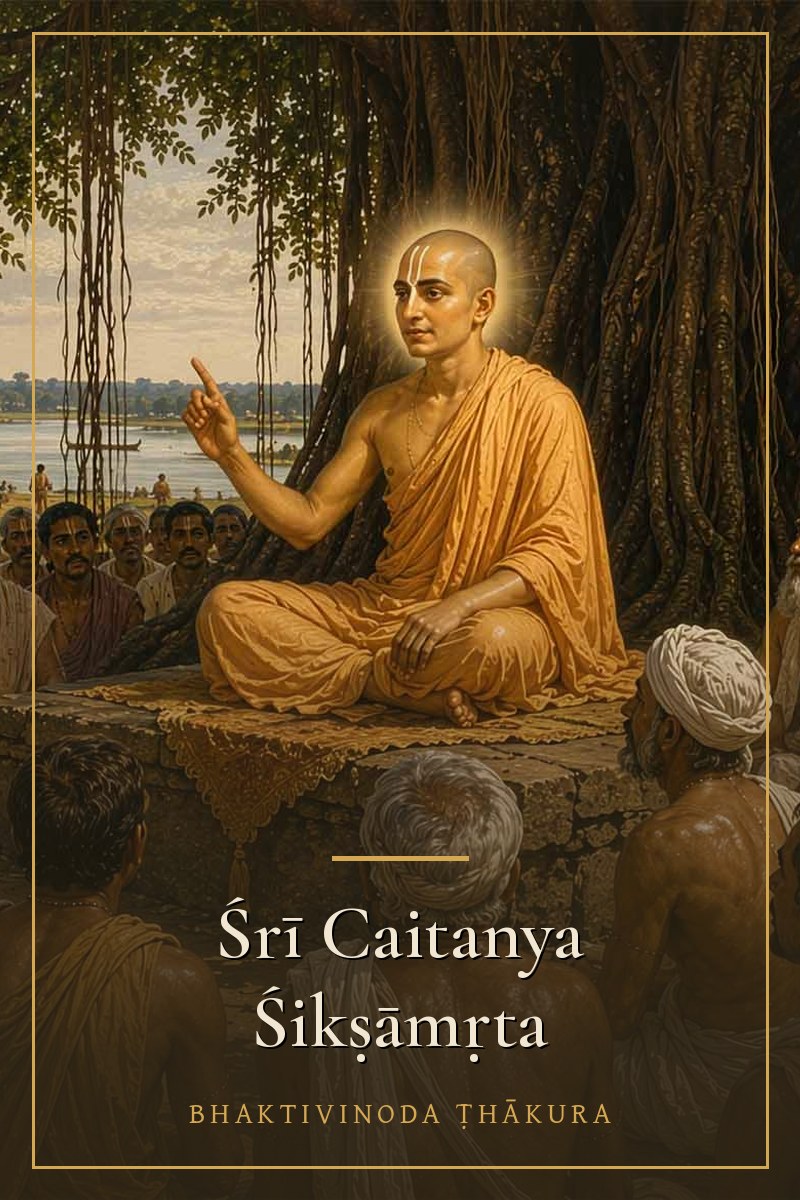
Śrī Caitanya Śikṣāmṛta
The Ambrosial Teachings of Śrī Caitanya
In This Book
- Introduction to First Edition (1886)
- Introduction to Second Edition (1906)
- First Shower – First Stream
- First Shower – Second Stream
- First Shower – Third Stream
- First Shower – Fourth Stream
- First Shower – Fifth Stream
- First Shower – Sixth Stream
- First Shower – Seventh Stream
- Second Shower – First Stream
- Second Shower – Second Stream
- Second Shower – Third Stream