
Dvitīya-Vṛṣṭi
(Second Shower)
Tritīya-dhārā
(Third Stream)
Qualification for Activities and an Analysis of Varṇa
Adhikāra, (qualification) is one of the principal principles of righteous conduct. The term adhikāra means eligibility. Qualification is of two kinds – namely, determining the particular activities for which a person is qualified, and determining the extent to which that person is qualified to perform those activities.
Not everyone is qualified to perform every pious activity. A person may indeed be qualified to perform a particular pious activity, yet may not be qualified to perform it in its entirety. Therefore, if someone undertakes an activity without first establishing their qualification, it cannot be said with certainty whether that activity will bear a result. For this reason, the determination of adhikāra must be undertaken before all else.
The person performing the activity cannot determine their own adhikāra. They must therefore first consult a qualified guru concerning their eligibility. Once the prescribed activity is to be performed, it is the duty of a purohita (ritualistic priest) to determine the proper procedure. This is precisely why people should select a qualified guru and priest.
The manner in which gurus and priests are selected nowadays is not what the authors of the śāstras intended. Selecting someone as a guru or purohita merely in name is as meaningless as selecting a puppet. One should select a person of genuine qualification from within one’s own village. If no such person can be found there, one should look elsewhere.
It is necessary to give examples of qualification for particular activities; otherwise, the matter will not be readily understood.
The excavation of a pond is one such pious activity. If a person undertakes the excavation with their own hands, they must possess the requisite physical strength, tools, land and assistance to be qualified for the work. If, instead, they arrange for the pond to be excavated by spending money, then they must possess the necessary financial means. The extent of one’s qualification for this undertaking is determined by the amount of physical strength, tools, land and assistance, or financial resources, at one’s disposal.
No result is obtained from undertaking an activity without the requisite qualification; moreover, attempting to perform it without such qualification results in pratyavāya (a negative result).
For the undertaking of marriage, certain qualifications are essential, including physical fitness, the capacity to maintain a household, and the appropriate mental disposition for conjugal life.
Thus, whatever activity one may wish to undertake, one’s qualification to perform it should first be determined.
Adhikāra is of two kinds – inherent qualification (svabhāvagata adhikāra) and situational qualification (avasthāgata adhikāra).
Human life may be divided into three stages – the period of education, the period of activity, and the period of rest. The period during which a person continues to acquire knowledge is their period of education (śikṣā-kāla). During this period, through the study of books, association with others, observation of the activities of others, and the reception of instruction, whichever particular disposition becomes predominant in a person is called that person’s svabhāva (inherent disposition).
The family into which a person is born often determines the nature of the books they study, the instruction they receive, and the company they keep. These circumstances generally differ according to family background, and consequently, dispositions contrary to one’s familial nature are also observed in many cases. The essential point is this – when the period of education has come to an end, the disposition observed in a person on the threshold of their active life is considered to be that person’s svabhāva.
Those thoughtful persons who are capable of classifying things through the application of systematic knowledge have described svabhāva as being of four kinds:
1) brāhma-svabhāva (brāhmaṇa nature)
2) kṣatra-svabhāva (kṣatriya-nature)
3) vaiśya-svabhāva (vaiśya-nature)
4) śūdra-svabhāva (śūdra-nature) (1)
(1) śamo damas tapaḥ śaucaṁ santoṣaḥ kṣāntir ārjavaṁ
mad bhaktiś ca dayā satyaṁ brahma-prakṛtayas tv imaḥ
tejo balaṁ dhṛtiḥ śauryaṁ titikṣaudāryam udyamaḥ
dhairyaṁ brahmaṇyam aiśvaryaṁ kṣatra-prakṛtayas tv imaḥ
āstikyaṁ dāna-niṣṭhā ca adambho brahma-sevanam
atuṣṭir arthopacayair vaiśya-prakṛtayas tv imāḥ
śuśrūṣaṇaṁ dvija-gavāṁ devānāṁ cāpy amāyayā
tatra labdhena santoṣaḥ śūdra-prakṛtayas tv imāḥ
The qualities of the brāhmaṇas are peacefulness, self-control, austerity, cleanliness, contentment, forbearance, simplicity, devotion to Me, compassion and truthfulness.
The qualities of the kṣatriyas are power, strength, determination, heroism, tolerance, generosity, enterprise, courage, devotion to the brāhmaṇas and opulence.
The qualities of the vaiśyas are faith in the Vedic principles, dedication to charity, freedom from hypocrisy, service to the brāhmaṇas, and dissatisfaction with the accumulation of wealth.
The qualities of the śūdras are the sincere and honest service of the brāhmaṇas, cows and demigods, and contentment with whatever is obtained through such service. (Śrīmad Bhāgavatam 11.17.16-19)
ahiṁsā satyam asteyam akāma-krodha-lobhatā
bhūta-priya-hitehā ca dharmo ’yaṁ sārva-varṇikaḥ
The universal duties for all the varṇas are non-violence, truthfulness, refraining from stealing, freedom from lust, anger and greed, and acting for the pleasure and welfare of all living beings. (Śrīmad Bhāgavatam 11.17.21)
1. Brāhma-svabhāva – That nature from which arises a natural inclination towards the restraint of the internal senses, the control of the external senses, forbearance, purity of conduct, forgiveness, simplicity, the study and cultivation of knowledge, and the worship of the Supreme Lord, is designated as brāhmaṇa-svabhāva.
2. Kṣatra-svabhāva – That nature from which arise such qualities as heroism, vigour, determination, skill, fearlessness in battle, generosity, the protection and governance of the world, and the worship of the Supreme Lord, is designated as kṣatriya-svabhāva.
3. Vaiśya-svabhāva – That disposition from which arise inclinations towards agriculture, cattle rearing, and trade is designated as vaiśya-svabhāva.
4. Śūdra-svabhāva – That disposition from which arises an inclination to maintain oneself solely through the service of others is designated as śūdra-svabhāva.
5. Antyaja-svabhāva (Outcaste nature) – The nature of those persons who have no sense of what should be done and what should not be done, who refrain from righteous conduct, are perpetually quarrelsome, utterly selfish, wholly absorbed in the gratification of the belly, and devoid of any prescribed regulations governing marriage, is designated as antyaja-svabhāva. Unless this disposition is abandoned, a person cannot attain a truly human nature. Therefore, there are only four kinds of nara-svabhāva (human disposition).
One should accept the nature or qualities arising from one’s svabhāva, and undertake activities in accordance with them. When one attempts to perform activities contrary to one’s natural disposition, those activities can neither be carried out properly nor produce their intended results.
To determine a person’s varṇa according to their svabhāva is both scientific and approved by the Āryan sages. A certain aspect of svabhāva is called ‘genius’ in the English language. Once a person’s disposition has matured, it is not easily changed. Therefore, it is one’s duty to earn a livelihood and pursue the supreme spiritual goal by performing activities in accordance with one’s natural disposition.
In this land of India, human beings have acquired the four varṇas according to the four natures described above. When people are organised within society through this division of varṇa, social activities naturally become productive, and the welfare of the world as a whole is achieved.
The foundation of a society that follows the prescribed system of varṇa is scientific, and such a society is worthy of the reverence of all humanity.
Some may raise the following objection – if the people of Europe have become highly accomplished and respected in other countries without accepting the system of varṇa, then surely there is no practical necessity for accepting it.
This objection is without foundation, because the European nations are comparatively young and modern. People belonging to newly established nations are generally stronger and more daring. Through their strength and courage, they have acquired much accumulated knowledge, science, and technical skill from earlier civilisations, and have thereby been able to perform various kinds of work in the world.
However, as a nation gradually advances in age, it will quickly decline in the absence of a society founded upon scientific principles.
Among the Āryan people of India, the system of varṇa has remained established, and therefore, even in old age, the characteristic identity of the nation continues to manifest.
At one time, the Roman and Greek peoples were even stronger and more vigorous than the modern European nations. What is their condition today? Having lost their distinctive national characteristics, they have adopted the customs and characteristics of other modern nations and have consequently been transformed into something quite different. Indeed, they no longer take pride in the manliness and heroic qualities of their own ancient national heroes.
Although the Āryan people of our country are much older than the Roman and Greek nations, they still retain their pride in the heroic figures of India’s ancient past. Why is this? It is solely because the system of varṇāśrama has remained strong, and their distinctive national characteristics have therefore not disappeared. Even to this day, the descendants of kings regard themselves as heroic descendants of the lineage of Rāmacandra.
However much the people of India may decline during the old age of their nation, so long as the system of varṇa remains in practice, they will remain Āryan rather than become non-Āryan.
The European peoples, along with the Romans and others of Āryan descent, have become intermixed with outcaste peoples such as the Huns and the Vandals. If one examines the present social organisation of the European nations, one will find that whatever measure of order and excellence exists in those societies is itself founded upon natural varṇa-dharma.
In Europe, a person of mercantile disposition loves commerce and advances through trade. A person of a kṣatriya nature adopts the military profession or the occupation of a soldier. Those of śūdra nature prefer ordinary service occupations.
In reality, no society can function without following varṇa-dharma to some extent.
Even in matters such as marriage, distinctions of higher and lower status according to varṇa, as well as a person’s svabhāva, are taken into consideration.
Although European societies have been established by following varṇa-dharma to some extent, this system has not yet attained its complete scientific form among them. As civilisation and knowledge advance in Europe, varṇa-dharma will become increasingly complete.
In every sphere of activity, there are two kinds of methods – the non-scientific method and the scientific method. Until a scientific method is adopted, a particular activity continues to be carried out by non-scientific means. For example, before vessels began to be constructed according to scientific principles, the work of water transportation was carried out by means of non-scientific vessels such as ordinary boats.
Society operates in precisely the same way. Until the system of varṇa is properly established and implemented in a particular country, society continues to be governed by an undeveloped, non-scientific preliminary form of that system. It is this non-scientific preliminary form of varṇa that continues to govern society in Europe – and, broadly speaking, everywhere outside India. For this reason, India has been designated as the karma-kṣetra (the field of action).
The present system of varṇāśrama has become corrupted. The question now arises, is the system of varṇa presently functioning in India in a healthy condition?
The answer is no.
Although the system of varṇa was once fully established in India, it eventually became unhealthy, resulting in much suffering and decline for the country. Otherwise, even if the people of India, through the natural ageing of their nation, had withdrawn from activities such as warfare, they would have continued to live happily, like an elder brother who has retired from active duties, serving as advisers to other nations. It is therefore necessary to consider the nature of this unhealthy condition.
At the beginning of the Tretā-yuga, when the Āryan people had attained sufficient advancement in the study of science and knowledge, the system of varṇāśrama was established. (2) The following principle was then laid down: every person would acquire a varṇa according to their svabhāva, receive the corresponding eligibility and adhikāra, and perform the duties prescribed for that particular varṇa. Through the proper division of labour and the systematic determination of svabhāva, the activities of the world were conducted in an orderly and harmonious manner.
(2) ādau kṛta-yuge varṇo nṛṇāṁ haṁsa iti smṛtaḥ
kṛta-kṛtyāḥ prajā jātyā tasmāt kṛta-yugaṁ viduḥ
vedaḥ praṇava evāgre dharmo ’haṁ vṛṣa-rūpa-dhṛk
upāsate tapo-niṣṭhā haṁsaṁ māṁ mukta-kilbiṣāḥ
tretā-mukhe mahā-bhāga prāṇān me hṛdayāt trayī
vidyā prādurabhūt tasyā aham āsaṁ tri-vṛn makhaḥ
vipra-kṣatriya-viṭ-śūdrā mukha-bāhūru-pāda-jāḥ
vairājāt puruṣāj jātā ya ātmācāra-lakṣaṇāḥ
In the beginning, in Satya-yuga, the varṇa of human beings was known as haṁsa. The people were naturally perfected in the fulfilment of their duties; therefore, that age is known as Kṛta-yuga.
In the beginning, the Veda was manifest as the sacred syllable Oṁ, and I appeared as Dharma in the form of a bull. Free from all sinful reactions, those who were firmly devoted to austerity worshipped Me as Haṁsa.
O greatly fortunate one, at the beginning of Tretā-yuga, the threefold Vedic knowledge manifested from My heart, which is the source of all life. From that threefold Vedic knowledge, I appeared as the threefold sacrificial system.
The brāhmaṇas, kṣatriyas, vaiśyas and śūdras were born respectively from the mouth, arms, thighs and feet of the universal form of the Supreme Person, Virāṭ Puruṣa. Their respective natures and conduct are the defining characteristics of these four social divisions. (Śrīmad Bhāgavatam 11.17.10-13)
A person whose father’s varṇa was unknown was assigned to a particular varṇa solely on the basis of their svabhāva. The Vedic histories of Jābāli and Gautama, Jānaśruti and Citraratha provide examples of this principle. Where a person’s father’s varṇa was established, however, both svabhāva and family lineage were taken into consideration when determining their varṇa.
In the Nirayatta lineage, Agniveśya himself became a mahaṛṣi known as Jātukarṇa, and from his lineage arose the celebrated Brahminical family known as the Āgniveśyāyanas.
In the Aila dynasty, Jahnu, the son of Hotraka, attained Brahminical status.
In the Bharata dynasty, Bharadvāja – whose royal name was King Vitatha – had descendants among whom the children of Nara became Kṣatriyas, while the children of Garga became brāhmaṇas.
In the lineage of King Bharmāśva, figures such as Śatānanda of the Maudgalya gotra and Kṛpācārya were born.
There are countless such examples in the śāstras; I have mentioned only a few of them.
It was during the period when such a system of genuine social formation and refinement (saṁskāra) was in practice that the sun of India’s glory shone with extraordinary brilliance, like the midday sun at its zenith.
At that time, all nations revered the people of India as rulers, dispensers of justice and punishment, and spiritual preceptors. The people of countries such as Egypt and China received instruction from the inhabitants of India with reverence and awe.
When the religious system of varṇāśrama had been practised in its pure form for a long period, a gradual corruption took place. Jamadagni and his son Paraśurāma, both of kṣatriya–svabhāva, were improperly classified among the brāhmaṇas. Acting contrary to the natural order of dharma, they broke the established principles governing the brāhmaṇas and kṣatriyas out of self-interest, thereby disturbing the proper relations between the two classes. As a result, the seeds of discord sown between these two varṇas gradually bore fruit, and the system of determining varṇa by birth alone began to take increasingly firm root.
In time, when this unnatural principle was secretly introduced into the śāstras, such as those of Manu and others, the kṣatriyas, having lost all hope of attaining a higher varṇa, established Buddhism and devised a means of bringing about the destruction of the brāhmaṇas.
Whenever a particular action arises, an equally powerful reaction inevitably follows. As a consequence of this, the system of determining varṇa by birth became even more firmly entrenched. Thus, two opposing natures – one, a corrupt social system and, the other, attachment to one’s own country and its established traditions – came into conflict. Gradually, these two forces brought the Āryan descendants of India to the verge of extinction.
Brāhmaṇas who possessed only the name and title of brāhmaṇa, but lacked brāhma–svabhāva, began composing self-serving religious codes and imposing restrictions upon the other varṇas.
The kṣatriyas, who lacked kṣatra-svabhāva, became incapable of warfare and consequently began losing their kingdoms. Eventually, they began propagating the insignificant doctrine of Buddhism.
The vaiśyas, who lacked the mercantile nature, began propagating Jainism and other such religions, and India’s once extensive commerce gradually declined.
The śūdras, who lacked the śūdra-svabhāva, were denied qualification for the occupations prescribed by their natural disposition and consequently became almost like bandits.
As a result, the study of the Vedas and other śāstras gradually disappeared. Rulers of Mleccha lands invaded India and took possession of it. The use of seafaring vessels fell into disuse, and even the system of service ceased to function properly. Thus, the influence of Kali became increasingly powerful. (3)
(3) gṛhasthasya kriyā-tyāgovrata-tyāgo vaṭor api
tapasvino grāma-sevā bhikṣor indriya-lolatā
āśramāpasadā hy ete khalv āśrama-viḍambanāḥ
deva-māyā-vimūḍhāṁs tān upekṣetānukampayā
ātmānaṁ ced vijānīyāt paraṁ jñāna-dhutāśayaḥ
kim icchan kasya vā hetor dehaṁ puṣṇāti lampaṭaḥ
A gṛhastha who gives up his prescribed duties, a brahmacārī who abandons his vows, an vānaprastha who engages in village affairs, and a sannyāsī who becomes attached to the gratification of his senses – these are all fallen members of their respective āśramas, merely imitating the external forms of spiritual life. Deluded by the Lord’s māyā, they should be disregarded, or shown compassion. If a person truly understands the self, and his heart has been purified by transcendental knowledge, why would he maintain his body through such material attachment? What could he desire, and for what purpose? (Śrīmad Bhāgavatam 7.15.38-40)
Alas! The present wretched condition of the Āryan people of India, who were once the rulers and spiritual preceptors of all nations, cannot be attributed solely to the ageing of the nation. Rather, it must be acknowledged that this condition arose through the establishment of an illegitimate system of varṇa.
If the Supreme Lord, who alone governs all living beings and all laws, and who is capable of establishing auspiciousness in place of every form of misfortune, so desires, He will once again empower some extraordinary person to re-establish the genuine principles of varṇa-dharma.
The authors of the Purāṇas, too, appear to have shared a hope such as ours, as they anticipated the advent of Kalki-deva and awaited His intervention.
Let us now proceed to examine the genuine principles of the system.
The dharma-śāstras prescribe the activities for which each varṇa is qualified. It would be difficult to present all of these prescriptions in detail in our book.
The following activities are reserved for brāhmaṇas – the giving of food in the practice of hospitality; the observance of ritual purity through bathing three times daily; the worship of the Deities; the recitation and study of the Vedas; the giving of instruction and the performance of priestly duties; the observance of vows such as upanayana; the practice of brahmacarya; and the acceptance of sannyāsa.
The kṣatriyas are qualified to perform such duties as righteous warfare, the governance of kingdoms, the protection of subjects, and the giving of substantial gifts.
The vaiśyas are qualified for the breeding and protection of livestock, agriculture, and commerce.
The śūdras are qualified to perform Deity service without the use of Vedic mantras, as well as to render service to the other three varṇas.
Men and women of all four varṇas are qualified to perform the following activities – the observance of marriage and other religious vows, devotion to the Supreme Lord, benevolent acts for the welfare of others, ordinary charitable giving, service to the guru, hospitality, the observance of purity, the celebration of religious festivals, service to cows, the improvement and purification of the world, and the practice of righteous conduct.
Women have a particular qualification for the service of their parents.
The fundamental principle is this – a person possessing a particular natural disposition is qualified to perform those activities suited to that disposition. Through the application of sound and straightforward judgement, almost everyone can determine their own qualification for particular activities. If they are unable to do so, they should consult a qualified guru.
If Vaiṣṇavas beyond the modes of nature wish to learn more about these matters, they should study Sat-kriyā-sāra Dīpikā, composed by Śrīmad Gopāla Bhaṭṭa Gosvāmī.
On The Same Subject
Related Articles and Books
Other works by Bhaktivinoda Ṭhākura
Books
Articles
From Other Vaiṣṇava Authors
Further Reading from Rupanuga Bhajan Ashram
Selected works by Vaiṣṇava authors from our sister websites
Articles
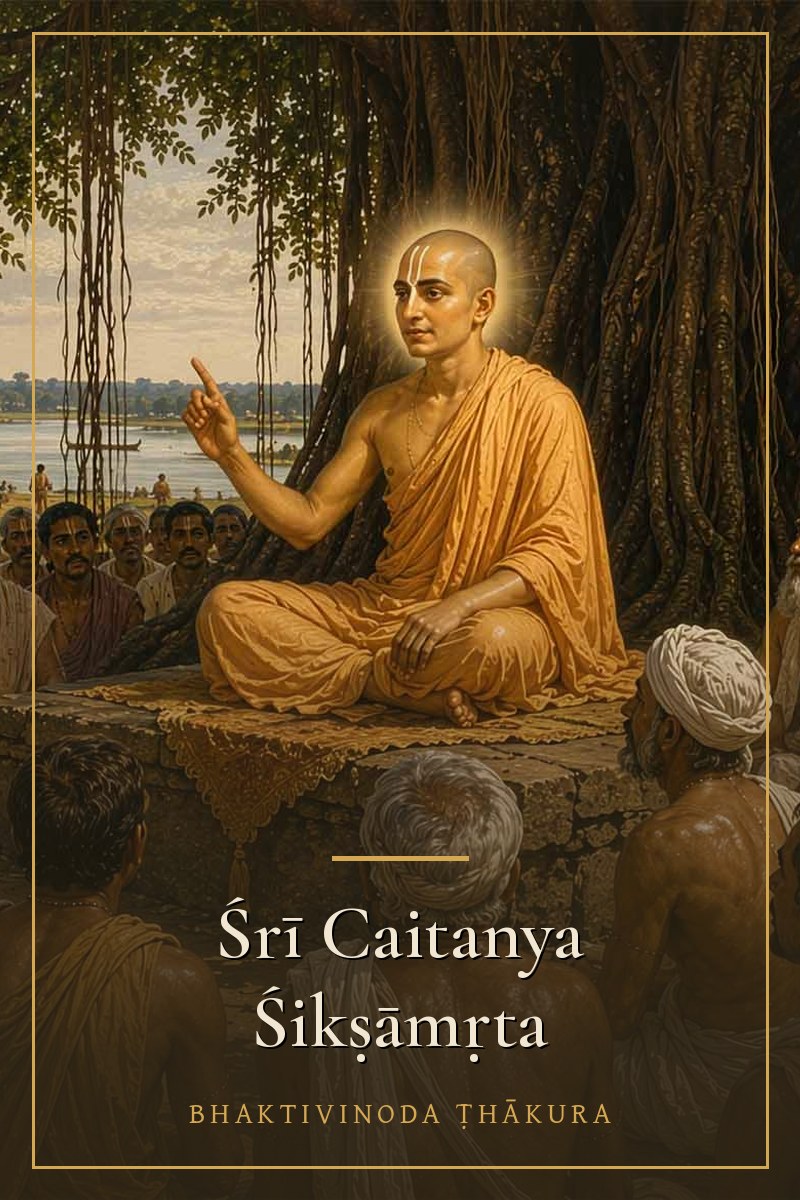
Śrī Caitanya Śikṣāmṛta
The Ambrosial Teachings of Śrī Caitanya
In This Book
- Introduction to First Edition (1886)
- Introduction to Second Edition (1906)
- First Shower – First Stream
- First Shower – Second Stream
- First Shower – Third Stream
- First Shower – Fourth Stream
- First Shower – Fifth Stream
- First Shower – Sixth Stream
- First Shower – Seventh Stream
- Second Shower – First Stream
- Second Shower – Second Stream
- Second Shower – Third Stream