
Vairāgya (Renunciation)
This article ‘Vairāgya’ by Śrīla Bhaktivinoda Ṭhākura seems to have been published after his disappearance by Śrīla Sarasvatī Ṭhākura in Sajjana Toṣaṇī, Vol.24. Issues 1-2. Bhaktivinoda had previously written a similar article in Vol.11, Issue 6, however, this more extensive article gives greater detail about the topic of renunciation, its characteristics and who is qualified to be a renunciate.

Epilogue to Śrī Kṛṣṇa Karṇāmṛta
The Epilogue to Śrī Kṛṣṇa Karṇāṁrta was first published in Sajjana Toṣaṇi, Vol.10 issue 5 in 1898. Bhaktivinoda Ṭhākura gives a brief synopsis of rāgānugā-bhakti and then lists various ślokas within Kṛṣṇa Karṇāṁrta that describe certain characteristics of rāgānugā-bhakti sādhana.

Vairāgya (Detachment)
Vairāgya (Detachment) was first published in Sajjana Toṣaṇī Vol.11, issue 6 in 1899. Bhaktivinoda Ṭhākura describes in detail the two kinds of renunciation and how they relate to viṣaya, material sense-objects.

Viśuddha Bhajana (Pure Bhajana)
Viśuddha Bhajana (Pure Bhajana) was first published in Sajjana Toṣaṇī Vol.11 issue 7 in 1899. This article by Bhaktivinoda Ṭhākura is a concise and important explanation of what is necessary to improve one’s bhajana in order to achieve prema.

Asat Saṅga (Materialistic Association)
Asat Saṅga (Materialistic Association) was first published in Sajjana Toṣaṇī Vol. 11, issue 6 in 1899. In this article, Bhaktivinoda Ṭhākura specifically defines two types of asat-saṅga, namely the strī-saṅgī (one attached to women) and kṛṣna-abhakta (one who is not a devotee of Kṛṣṇa)
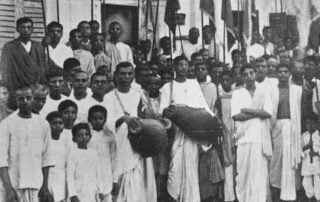
Kalikātāra Kīrtana (Kīrtana in Kolkata)
Kalikātāra Kīrtana (Kīrtana in Kolkata) was published in Sajjana Toṣaṇī Vol.11, issue 3 in 1899. Bhaktivinoda Ṭhākura happily reports on the many kīrtanas going on in the city of Kolkata, but also points out how the citizens may be initiating kīrtana due to the plague, and have not fully understood the true necessity of kirtana. He also mentions the unfortunate use of foreign musical instruments, as well as modern tunes being introduced into kīrtana

Kuṭīnāṭī (Politics and Duplicity)
Kuṭīnāṭī (Politics and Duplicity) was published in 1894, in two parts in Sajjana Toṣaṇī, Vol. 6, issues 3 and 7. In this essay, Bhaktivinoda Ṭhākura explains the meaning of kuṭīnāṭī according to the philosophy of Śrī Caitanya and also speaks about the verse from Gītā, ‘api cet suduracāro’ in relation to kuṭīnāṭī.

Asat-saṅga Parityāga (Abandoning Bad Association)
Asat-saṅga Parityāga (Abandoning Bad Association) was published in Sajjana Toṣaṇī, Vol. 4, Issue 5 in 1892. Bhaktivinoda Ṭhākura writes about the necessity of rejecting bad company, and especially describes Mahāprabhu’s phrase ’strī-saṅgi’ - being overly attached to one’s wife and not attached to Kṛṣṇa.

Viṣaya u Vairāgya (Sense enjoyment and Renunciation)
In this article, Viṣaya u Vairāgya (Sense enjoyment and Renunciation), first published in the 4th Volume of Sajjana Toṣaṇī in 1892, Bhaktivinoda Ṭhākura describes the gradual development of renunciation within one who lives in this world. He gives the example of Śrīla Raghunātha Dāsa Gosvāmī, and also warns against immature renunciation.

Saṅga-tyāga (Giving up the association of non-devotees)
There are two types of saṅga - association and attachment. One who is serious about advancement in bhakti should avoid bad association completely. Bhaktivinoda Ṭhākura ellucidates upon this point in this article, "Saṅga-tyāga (Giving up the association of non-devotees)" from Vol.10 of Sajjana Toṣaṇī.
 On 18th August 2012, on the occasion of his Vyāsa Pūjā, Śrīla Bhakti Gaurava Narasiṅgha Mahārāja announced to the devotees that he had a strong desire to create a website called “Bhaktivinoda Institute” in honour of Śrīla Bhaktivinoda Ṭhākura and his teachings in order to preserve and propagate them.